


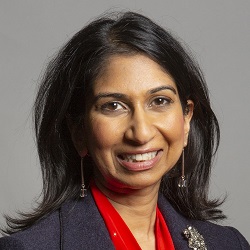
Braverman: Snowflake sensibility
Former Attorney General Suella Braverman KC has entered into a war of words with a trainee solicitor over a petition calling for reform of the Solicitors Qualifying Examination (SQE).
The petition started on Change.org by a trainee under the pseudonym of Hannah Cox, which has attracted 833 signatures as of last night, is targeted at the Solicitors Regulation Authority (SRA).
She wrote that she found the SQE “disproportionately challenging”.
She explained: “It has not only affected my academic life but has also taken a severe toll on my mental, financial, and physical well-being. This is a sentiment echoed by the vast majority of other candidates who have undertaken this exam.”
Ms Cox described the “opaque nature of the administration” of the SQE as one of the major concerns.
“The SRA has refused to disclose individual exam providers’ pass rates, eroding trust among candidates. Furthermore, instances of inaccurate exam results have been reported, raising doubts about the exam’s reliability and credibility.
“The appeals/mitigating circumstances process is inadequate and there is absolutely no accountability given the SRA’s refusal to publish any past papers.”
The SQE was also “perceived to be discriminatory”, she said, “with elements that favour certain backgrounds and learning styles, leaving many future solicitors at a disadvantage”.
The pressure and uncertainty surrounding the SQE was damaging mental health, she went on, “with many candidates enduring extreme stress and anxiety. This mental toll is an unacceptable consequence of an exam meant to broaden access to the profession”.
Ms Braverman wrote about the petition in an article in the Daily Telegraph, which said the legal profession was “the latest battleground in the war against excellence”.
She said the petition was aimed at making the SQE easier. She paraphrased it as: “We didn’t do well, and it must be someone else’s fault.”
Ms Braverman, who is also a former home secretary, continued: “There could hardly be a more telling parable of our times. The snowflake sensibility – once confined to undergraduate common rooms and the wilder fringes of social media – has now infected even the corridors of legal ambition.
“The future custodians of our justice system are not asking for a level playing field; they are asking for the pitch to be tilted until everyone scores.
“The argument, if we can call it that, is that maintaining high standards will inevitably restrict ‘diversity’ in the profession. And here we are again, at the familiar intersection where merit collides with identity politics – and where the latter is expected to triumph, no matter the cost. This isn’t about widening opportunity. It is about lowering the bar.”
The MP spoke about her experience of taking legal exams in England, France and New York: “They were not ‘inclusive’. They were not designed to reflect my personal learning style. They were difficult. That was the point. And when I passed them, I felt a precious sense of achievement and readiness for the real world of legal practice.”
The consequences “of this race to the bottom”, she went on, would be to undermine standards and ultimately the legal profession, “one of the UK’s most formidable exports”.
She concluded: “The question, then, is not whether the SQE is too hard. The question is: when did we become so soft?”
In response, Ms Cox argued that the politician had misquoted her. “Nowhere in the petition did I claim that the exam was ‘too hard’. I’m not a wet lettuce for Christ sakes.”
She explained that she considered the SQE disproportionately challenging because the SRA refused to publish past papers, meaning candidates could not adequately prepare.
Further, the cost of the exams was “extortionate” – comparing the combined £4,760 cost of the two exams to the New York Bar, which charges domestic candidates $250 and foreigners $750.
The SRA also refused to consider academic appeals – “but they always get the marking spot on, right?” (last year, 175 candidates who passed were told they had failed due to marking errors) – and the total cost of appeal was £1,200.
Signing off as ‘a snowflake’, Ms Cox also complained that candidates were denied access water during the exam and that the questions did not align with practice.
This latter point chimed with an unconnected LinkedIn post from last week by Alex Singleton, a solicitor apprentice at Leeds firm Oakwood Solicitors, which followed her sitting her last SQE1 exam.
She wrote: “The exams were draining. You’re expected to maintain your concentration for over five hours per exam, having only 90 seconds to answer each question and no spare time to collect your thoughts, except the 50 minute break you get in the middle.
“If you need a drink or the toilet in the session, this comes out of your precious exam time, which you can’t really afford to lose.
“Some scenarios were frankly bizarre and they could include things you’ve never seen before. Despite the time I dedicated to revision, there were still so many questions I wasn’t sure on.”
She said that although the aim was to test candidates based on the standards of a newly qualified solicitor, “having worked in personal injury for seven years, there were some questions I struggled to answer in this area”.
While the SQE was designed to be more accessible, “it couldn’t feel further from the truth”, Ms Singleton continued.
“I ranged 80-90% on my university exams when I was tested on individual modules and yet I don’t feel confident awaiting my SQE 1 results. It really can feel like they’re testing you to fail.”
In a report earlier this year, the independent SQE reviewer, Ricardo Lé, said: “The SQE is a high-stakes, complex and multi-faceted assessment. I have been assured, through my observations during the year, that it’s a robust and fair assessment. I have seen evidence of best practice and a strong commitment to continual improvement.”
 Adrian Lord
  Jamie humpheson
  Shaun
Shaun 





Totally agree, I know many student who’s mental health has suffered. Also the added pressure that if they fail they only have 3 takes withing a 2-3 year period. I for one started the course with Barbri, but due to family circumstances had to stop. £3,500 flushed down the loo on my part and was asked for am additional £600 if I wanted to defer… Another money making scheme from the powers that be it seems….