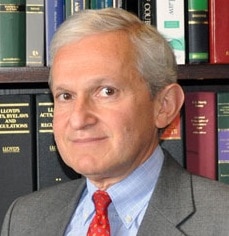
Vos: Legal community needs to prepare itself urgently
It is likely that “humans will come to accept, on economic grounds, machine-enabled resolution of small disputes”, the Master of the Rolls has predicted.
Sir Geoffrey Vos said the legal community “urgently” needed to have a debate about where the lines should be drawn between “machine-made” and “machine-assisted” judicial decisions.
It was “quite predictable that there will be pressures on all our justice systems to move towards allowing machines, at least, to advise judges” on decisions, he went on.
While “responsible guidance” issued by judiciaries in many countries “cautioned that judges were always personally responsible for their decision-making”, whether or not assisted by AI, it was “possible, even perhaps likely, that some judges will be tempted to use their LLMs [large language models] outside the guidance”.
Sir Geoffrey said he was “fairly sure that the use of AI to advise judges as to case outcomes, in common law countries at least, is likely to be some way ahead”.
He went on: “Human caution and circumspection is likely to mean that changes will be slow at first, but when they come, they may accelerate.
“And it is quite likely, I think, that humans will come to accept, on economic grounds, machine-enabled resolution of small disputes at first instance.”
Delivering the John Lehane memorial lecture to the Supreme Court of New South Wales in Australia, Sir Geoffrey – who is retiring this autumn – pointed to the announcement last December by the American Arbitration Association’s International Centre for Dispute Resolution of an AI arbitrator for two-party, document-only construction disputes up to a certain value.
The model includes a “human in the loop” – while the AI arbitrator will evaluate the merits of claims and prepare draft awards, a human arbitrator will review it to test the reasoning and evaluate the decision – in order to safeguard trust, transparency and due process.
“There is seemingly no reason of principle to prevent competent commercial parties from agreeing to such a dispute resolution method. Before too long, we will see how popular such mechanisms prove to be in practice.”
The judge said the “line that is to be drawn between machine-made judicial decisions and machine-assisted judicial decisions” was “hard to draw”.
AI was “rapidly improving” and would be able to “give ‘assistance’ to judges in a much shorter time than human judges will need to take to check what they are being told.
There was “probably no ‘rule of law’ problem” with judges using systems like Harvey or Legora to assist with legal research, but these programmes were also capable of answering the ultimate question raised by a legal dispute as well as just providing background legal information.
As confidence in the programmes grew, “one wonders how much judicial time and attention will be paid to checking the machine’s advice.
“Ultimately if a judge is presented with 1,000 decisions, economic and time pressures will inevitably lead to judicial approval of the machine’s recommendations.”
Sir Geoffrey said the Standing International Forum of Commercial Courts was “doing some ground-breaking work in this area, seeking to draw up some principles that can achieve broad consensus as to what is acceptable, and what is not acceptable, as to the use of AI in relation to machine-made or machine-assisted decisions in commercial and arbitration cases”.
He said: “I believe the legal community needs to prepare itself urgently.
“We need to have an informed debate about where the lines are to be drawn so as to preserve the humans’ rights to an independent and impartial human judicial decision, save where there has been freely and fully informed consent given to machine-made decision-making.”
He added: “Legal systems and legal professions depend on public trust and confidence.
“It would damage that public confidence if those providing legal services and dispute resolution services appeared protectionist or self-serving in the face of ever-more-capable AI systems that can provide reasonable, if less orthodox, assistance to lawyers and judges.”