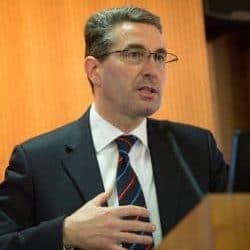
Philip: No findings of fact in the report
The leaders of the Solicitors Regulation Authority (SRA) yesterday refused to apologise to the profession about the Axiom Ince collapse as they dismissed the report criticising its actions as just opinion.
Asked directly by Legal Futures whether she would apologise to solicitors in the wake of the independent report commissioned by the Legal Services Board, Anna Bradley refused, saying the regulator would go no further than its statement last week.
This said: “There is a lot in the report that we do not agree with, including the headline conclusions. In particular, it is by no means clear that a different approach would have uncovered the issue sooner.
“With hindsight, the report has highlighted things that we could – rather than just should – have done. But in our view, it is unrealistic to expect regulation to prevent all harms…
“While we accept there are things we might, in retrospect, have done differently, in our view they don’t go to the heart of the matter.”
The headline conclusions were that, in the lead-up to the SRA closing Axiom Ince in October 2023, it “did not act adequately, effectively and efficiently”, did not take all the steps “it could or should have taken”, and that its “actions and omissions in this matter necessitate change in its procedures to mitigate the possibility of a similar situation arising again”.
Speaking to the media during yesterday’s compliance officer conference in Birmingham, Ms Bradley and chief executive Paul Philip declined to detail which specific aspects of the report, written by Northern Irish law firm Carson McDowell, the SRA disputed.
However, he reacted strongly when asked if he accepted the finding that, during an inspection of Axiom Ince in October 2022 prompted by an unrelated issue, the SRA missed an opportunity to identify the alleged wrongdoing at the firm.
“There’s no evidence to prove that at all. In fact, there’s no evidence at all – there are no findings of fact in the report,” he said. “It’s all opinion from Carson McDowell and therefore getting into a discussion about what we disagree with, we just don’t think is fruitful at this point in time…
“[The report] starts with a discussion saying that ‘we have not used the standard of proof’ [it actually says ‘We have not applied a criminal standard of proof to our report when assessing the evidence’]. If you don’t use the standard of proof, it’s very difficult to come to a finding of fact.”
Ms Bradley noted that Carson McDowell also said that “different people might reach different conclusions”.
Mr Philip added: “At the heart of the Axiom Ince collapse was a serious, well-disguised suspected fraud by a solicitor. There’s half a dozen or so people who have been investigated by the Serious Fraud Office.
“So, if you want someone to blame, I think you’ve got to blame the people who are subject to criminal investigations.”
The Legal Services Board intends to use its enforcement powers to issue ‘directions’ to the SRA to take specific actions to avoid a repeat of the events leading up to Axiom Ince’s closure.
Mr Philip said draft directions were likely to be published within weeks.