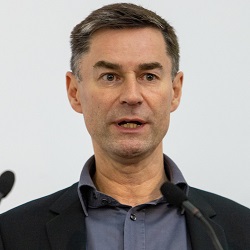
Waldie: Difficult decision to step back
Listed law firm Gateley yesterday issued a mixed set of results, with revenue up by 8.2% but debt quadrupling to £25m, while it is planning to cut up to 40 support staff.
Meanwhile chief executive Ron Waldie is stepping down from the role next month for “personal, health-related reasons”.
Shares in Gateley – 11 years on from becoming the first listed law firm in the UK – have been slipping over the past five years and closed yesterday at 59p, having ended 2025 at 103.5p.
This has been despite steady financial results and diversification by acquiring businesses offering complementary professional services, most recently intellectual property specialists Groom Wilkes & Wright, which it bought last September for an initial £5.7m.
In the year to 30 April, revenue hit £194m, while adjusted profit before tax was down 7.1% to £22m, “driven primarily by a decrease in net interest income”. However, on a statutory basis, operating profit almost doubled to £7.5m.
The firm said the increase in its net debt over the year, from £6.6m to £25.3m, was driven by “increased working capital, alongside acquisition consideration payments, dividends paid” and buying shares from employees.
In his chief executive’s report, Mr Waldie said “cost actions” were taken throughout the previous financial year “to reduce some of our under-utilised or lower margin fee-earner headcount”, as reflected in the decrease in lawyer numbers from 1,024 to 983.
“Going into FY27, we continue to maintain our cost focus and have recently announced further proposed cost actions to reduce the size of some of our support teams, with a redundancy consultation process of up to around 40 staff currently underway.
“These specific cost reduction actions coupled with ongoing careful cost control should support productivity and operational leverage alongside improving margins through FY27 and beyond.”
On his own departure after six years, Mr Waldie said he was “stepping back from the CEO role very shortly due to personal, health-related circumstances” and “while it has been a difficult decision to step back it is the right one for my family and me”.
Martin Pike, who joined Gateley in April 2025 as an independent non-executive director and chair of the audit committee, becomes interim chief executive with effect from 1 August.
Mr Pike spent nearly 30 years at insurance broker and consultant Willis Towers Watson, where he led the EMEA risk consulting and software business and was a member of the global leadership team.
Mr Waldie said that “against the backdrop of a year of significant external challenges and macroeconomic uncertainty”, he was particularly pleased by Gateley’s overall performance, which “delivered organic revenue growth comfortably ahead of initial expectations”.
He went on: “This is our eleventh consecutive year of revenue growth since IPO; an unbroken track record delivered through multiple economic cycles.
“The group is now larger and more diversified than ever across legal and professional services and is well positioned to deliver profitable growth and sustainable margin improvement over the coming years.”
Mr Waldie said the firm’s “initial expectations at the half-year stage were for transactional uncertainty in the build-up to the November budget to resolve” as the firm progressed through the second half.
“This proved partially true until the Middle East crisis further impacted client confidence. The overall effect has been what we believe will be a specific, short-term impact on our Dubai operations, and a broader dampening effect on transactional activity in the UK.
“These, coupled with concerns around the medium-term interest rate outlook, meant we have seen a range of transactional timelines either pausing or extending in Q4.”
Mr Waldie said Groom Wilkes & Wright had “performed well in the year, trading above expectations”.
It had extended the group’s reach in trade mark work, “while further enhancing the development of complementary business services with an IP and brands focus”.
The Gateley board recommended a final dividend of 2p, down from 6.2p last year.
The reflected a decision to “rebase” the dividend to distribute up to around 45% of adjusted profits, “retaining a strong payout ratio, while also placing the dividend on a more sustainable footing and providing greater flexibility to deliver both progressive dividend growth and other shareholder returns”.