


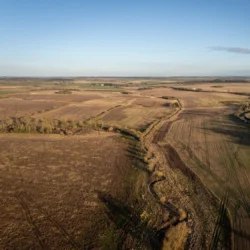
Boothby Wildland: Law firms to fund restoration until 2076
Three insurance law firms have agreed to provide 50 years of funding for a major new rewilding project.
Clyde & Co, DWF and Keoghs have joined a new consortium, led by the insurer QBE, that is bringing wildlife and natural habitats back to Boothby Wildland, a 1,500-acre site in Lincolnshire.
After decades of industrial wheat farming at Boothby, which came to an end in 2024, the land is classed as some of the most ecologically depleted in Britain.
The long-term funding from the three law firms will help pay for nature restoration specialists to store carbon in the soil.
By 2076, the site is expected to remove and store 138,000 tonnes of carbon from the atmosphere; the equivalent of more than 80,000 return flights between London and New York.
The project – managed by Nature Broking – will also generate around 25,000 verified carbon credits under the UK Carbon Code (UKCCC), a nature-based carbon standard.
Rewilding projects approved under the UKCCC need to achieve net zero emissions across the entire site before any carbon credits are issued.
This means that any investment at Boothby – such as the funding from Clyde & Co, DWF and Keoghs – will lead to real-world environmental benefits across the 1,500-acre site, rather than, for example, offsetting emissions at a different location.
Paddy Linehan, chief sustainability officer at Clyde & Co, which is investing £50,000, said: “Sustainability in professional services is often framed as an individual commitment; what each firm does within its own walls.
“The QBE Buyers Club is a different proposition entirely: it asks what becomes possible when businesses invest together, across the relationships that already connect them.”
Clyde & Co, DWF and Keoghs are part of QBE’s insurance claims supply chain. In the new consortium they are working alongside the Prism Claims Group, risk and claims administrator Sedgwick, and accident repair group FMG.
In recent years, the insurance industry has increasingly seen the impact of climate change. In 2024, UK insurers paid out a record £585m in home weather-damage claims; a rise of nearly 30% on 2023 and nearly double the amount from five years ago.
The growing crisis is what inspired the new consortium to take “meaningful action on nature and climate”.
A spokesman for the QBE Buyers Club said it was believed to be the first carbon-friendly consortium of its kind in the UK and showed how professional services firms are moving away from their own individual sustainability projects to “collective investment across the relationships that connect them day to day”.
The rewilding of the old farmland will lead to the creation of new grassland, wetland, woodland and scrub habitats, which will become home to a huge number of wildlife and plants.
Abi Duff-Walker, head of sustainability at DWF, added: “Collaborating through high-impact partnerships is a key focus of our ESG and sustainability strategy.
“The QBE Buyers Club presents an opportunity to extend that commitment and amplify our impact, leveraging our client and peer relationships to accelerate action on climate change and nature loss.”
There are already signs that the farmland at Boothby is starting to recover and nature is starting to return.
A family of four beavers were introduced in February. The dams they have built in the West Glen river will restore wetland habitats, improve water quality and help replace lost biodiversity at the former farm.
Last month, Nattergal – which bought the Boothby site in 2021 for £13.8m – released new data that showed in the last 12 months biodiversity across the site increased by nearly 110%.
More than 150 varieties of birds, bats, bees, butterflies and plants were spotted – an increase of one third – with the number of grey partridge, quail and meadow pipits increasing “substantially”. Otters and polecats have also returned.
Archie Struthers, Nattergal’s CEO, said: “Boothby Wildland shows what’s possible when we give nature the space and time to recover. What’s particularly exciting is that these outcomes are being delivered through a model that combines public support, private investment and rigorous ecological monitoring.
“As pressure grows on the environment, Boothby demonstrates that large-scale nature recovery can deliver measurable biological impact while creating long-term value for society.”
The next step will see free-roaming cattle and pigs introduced at Boothby, to naturally manage the vegetation and help the soil to recover.
Connie Cobb, a partner at Keoghs, said: “By working alongside our peers and aligning around shared goals, we can multiply our impact and accelerate meaningful progress. Through collective action, we are supporting the industry-wide transition to a lower-carbon future.”











