


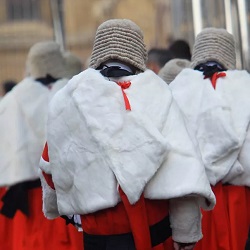
Judges: Disability under-represented
The Bar Council has backed plans by the Judicial Appointments Commission (JAC) to add disability to the ‘equal merit’ provision (EMP) it applies to the selection of judges, alongside ethnicity and gender.
The Bar Council said it expected that extending the EMP to disability would “increase confidence in judicial selection processes” by making it easier to tackle the under-representation of disabled people.
Under the EMP, where the JAC decides that two or more candidates in a selection exercise are of equal merit, it can give priority to candidates on the basis of ethnicity and gender.
In 2025-26, the JAC shortlisted 40 candidates and recommended 14 at the final decision-making stage as a result of it.
Lord Justice Warby, then a senior judicial commissioner, said last year that the JAC was “actively exploring” extending the EMP to disability.
A consultation, which was put out to stakeholders but not published and has now closed, said the publication of disability data for the judiciary for the first time last year provided, along with this year’s figures, “a suitable dataset to demonstrate that disabled people are underrepresented in the judiciary as a whole” – 11% of judges as against 18% of the adult working population as a whole.
There was no data to show underrepresentation by another protected characteristic, sexual orientation, however.
A JAC analysis indicated that an expansion of the EMP to disability “would be likely to result in a small increase in the number of disabled candidates recommended each year”.
As well as testing support for the move, the consultation asked whether the EMP should apply only at shortlisting or also at the selection stage.
The Bar Council said it should be both: “We believe that extending EMP to disabled applicants would support the JAC’s statutory duty to encourage diversity in the range of people available for judicial appointment…
“We would highlight that the EMP is a provision to be specifically applied where the need for it exists rather than a policy.
“We also note that its use should be reviewed at regular intervals to demonstrate that it remains required and is operating appropriately. This would ensure that the JAC has the relevant data to explain the basis for applying the EMP if asked by an applicant.”
A JAC spokeswoman told Legal Futures: “We welcome the positive engagement with this light-touch consultation which will help shape the future of the EMP. All responses are being considered, and our next steps following the consultation will be published in due course.”
Separately, the JAC has announced a pilot across four large judicial selection exercises to reduce the time the process takes.
Some roles take more than 50 weeks to recruit for but in his Independent Review of Criminal Courts, Sir Brian Leveson called for a more flexible recruitment model to help improve resource forecasting for the courts.
In response, the pilot will remove the online scenario test used as a shortlisting stage and “refocus the selection day onto the roleplay with additional follow-up questions, to closer replicate the job candidates are applying for”.
The JAC said these changes could cut timelines by a quarter.
The four competitions are for deputy district judge, fee-paid judge of the First-tier Tribunal (Immigration and Asylum Chamber), deputy district judge (magistrates’ court), and fee-paid employment tribunal judge.
“Our priority remains retaining a rigorous assessment method that is fair to candidates from all backgrounds and ensures only the most meritorious candidates are recommended for judicial office.
“It is felt that these changes, in reducing the shortlisting stages and refocusing the selection day, allow us to deliver exercises at a greater pace, whilst ensuring that assessment of candidates’ key judicial skills is considered in depth.”
To be successful candidates will still have to go through an online qualifying test, complete a full application, the selection day and character checks before reaching the selection and character committee, which recommends appointments.












Leave a Comment