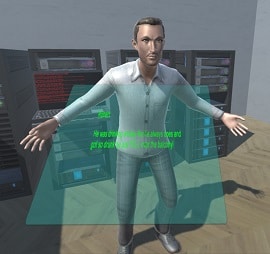
The virtual reality game in action
Academics at Westminster Law School have joined forces with their counterparts in the university’s Department of Computer Science to create a virtual reality ‘game’ that they hope will teach students criminal law.
The project, called REVRLaw (REal and Virtual Reality Law) is now being tested for how effective it is in helping students with the law of murder on the LLB course and the Integrated Masters in Law criminal law module.
It will allow the students to explore a real case scenario using virtual reality technology. They will discover important pieces of evidence and make up their mind over whether it is murder or not. The game-based platform integrates the immersion into Virtual Reality as the perception of being physically present in a non-physical world.
The project won the best paper award at the Immersive Learning Research Network conference this year. According to the paper, “serious games” – those thought to have educational value – can be very effective as an instructional tool, and can promote student motivation and interest in the subject matter.
Senior computer science lecturer Markos Mentzelopoulos said: “We hope that this new proposed platform will bring a new immersive learning experience to the law students and provide them with a completely different perspective…
“This project will not be used as a substitute of the original lecture materials but as a supplementary material to provide a different angle to the potential crime investigator.”
Senior law lecturer Dr Paresh Kathrani added: “This platform provides a state-of-the-art opportunity for criminal law students to expand upon the valuable skills that they learn on a law degree. It immerses them in a realistic crime scene and requires them to use those skills.”