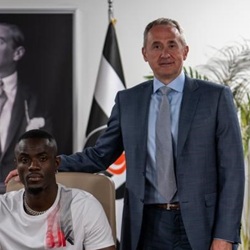
Chris Farnell (right) acted on the 2023 transfer of Eric Bailly from Manchester United to Beskitas
Photo: IPS Law X account
A High Court judge has rejected a high-profile sports lawyer’s challenge to an intervention in his law firm by the Solicitors Regulation Authority (SRA).
His Honour Judge Hodge KC, sitting as a High Court judge, said he was “entirely satisfied that there was, and is, good reason to suspect dishonesty” on the part of Chris Farnell, senior partner and sole owner of IPS Law.
HHJ Hodge said Mr Farnell, who has acted for the likes of Cristiano Ronaldo and Tyson Fury, “should not have been lending his name, his bank account, and his support” to “dubious investment schemes”.
The judge went on: “I am satisfied that the continuing risk to investors, who have still not received back their money, and potentially to others who might be approached to invest in similar schemes, fully justified the intervention in the present case, notwithstanding the drastic effect it has had upon Mr Farnell and his practice.
“This is a case where, even now, Mr Farnell appears to have no insight into the serious risks faced by the third parties who invested monies through his client account.
“Mr Farnell appreciated that the reason for his very involvement was the semblance of respectability, and security, that a solicitor’s client account would present to investors.”
The High Court heard that the SRA received complaints in 2023 relating to £1m held by IPS Law on behalf of Dux Fortis Holdings, £250,000 on behalf of Raleigh Financial and £750,000 on behalf of Craig Freeman.
Mr Farnell was not interviewed by the SRA until 2024 and the regulator did not complete its investigation until November 2025, when it intervened.
An interim forensic investigation report had been produced in August 2025 and a notice recommending intervention was issued in October 2025. That referred to four other claims which the SRA had received but not fully investigated by then.
The interim report made “serious allegations of misconduct” against Mr Farnell and his practice, the judge recounted.
“These include allegations that he had dishonestly participated in what were described as ‘dubious investment schemes’, whereby investors entrusted very large sums of money to the practice, to be held in its client account, only for those funds then to be paid away to third parties.
“The report identifies emails that were sent by Mr Farnell in which he told the investors that the funds remained held within the firm’s client account when in fact payment out of those funds had already taken place.
“The investigation report also identified a further case, that of Mr Freeman, where an individual had made payments in the expectation of investing in shares in a football club (although there was some issue as to whether this was a direct investment or through a company) but he had never received any shares.”
Counsel for Mr Farnell submitted that there were never any proper grounds for finding rule breaches or for suspecting dishonesty, and in any event the intervention should be withdrawn as disproportionate.
He said there was evidence from the solicitor “as to variations of the original terms of engagement, which he says had altered the basis upon which the funds were held”, leading to “a drastic, and serious, over-reaction” by the SRA.
However, HHJ Hodge said that analysis of emails showed that “not only did Mr Farnell falsely represent that Dux Fortis’s money was retained within the claimant’s client account, but that further emails were sent maintaining that position, notwithstanding that, simultaneously, further substantial sums were being paid out”.
Mr Farnell argued that this was “a mistake as a result of a failure of communication between himself and a representative of his firm”, but counsel for the SRA stressed that, according to the solicitor, the “innocuous mistake was never corrected”.
Further emails from Mr Farnell “continued to convey the impression that funds were coming back imminently, whilst at the same time funds were continuing to make their way out of the account”.
HHJ Hodge said he found it “difficult to understand the reasons for the delay” by the SRA in its investigation, “unless this was attributable to a lack of resources” but this was not “sufficient reason” to allow Mr Farnell’s claim.
The judge dismissed the claim, assessed the costs to be paid by Mr Farnell at just under £40,000, and refused permission to appeal.
Mr Farnell told Legal Futures that he is pursuing an appeal.
Last month, District Judge Obodai in Manchester made IPS Law subject to a compulsory winding up order over £421,000 owed to former client Global Sports Data and Technology Group Ltd.
IPS Law came off the wrong side of a High Court dispute with Global Sports Data over a project they had been working on together, with the Senior Courts Costs Office ruling last summer that they had a commercial, rather than a solicitor-client, relationship.
‘Project Red Card’ concerned possible claims over the allegedly unlawful collection and use of footballers’ performance data by gaming, betting and data processing companies.