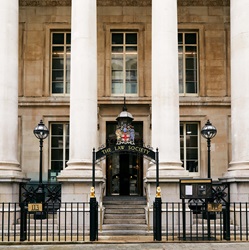
Law Society: New SGM rules
Solicitors have narrowly voted to increase the threshold for calling a special general meeting of the Law Society – despite the society’s ruling council no longer backing it.
Only 5,272 solicitors – 2.4% of the society’s 218,000-strong membership – voted and 2,644 were in favour, with 2,411 against. A further 217 members abstained.
That represents a wafer-thin majority – 50.2%. At October’s annual general meeting, where there were 139 votes, it was 52% against.
The motion was to raise the number of signatures required to call an SGM from 100 to 0.5% of the membership – or 1,080 on a current membership of around 216,000.
The uncertainty a percentage, rather than a precise number, would entail at the point campaigners would seek to call an SGM was one of the many objections.
The change provides too that an SGM could not be called for a motion which would be ineffective if passed, for example because its implementation was not possible under Chancery Lane’s functions and powers, or which was “frivolous or vexatious”.
It is not clear how the latter criteria would be applied.
After losing the vote at the AGM, the then president, Richard Atkinson, immediately invoked the society’s bye-laws to call for a ballot of the whole membership, given how close it was.
It later emerged that council members were not aware that this was the plan in the event of losing and the council’s support for the motion was withdrawn after a special meeting called by 25 members.
However, there was no mechanism within the society’s bye-laws to stop the ballot.
The bye-laws allowed the council to make a statement on the ballot but the Law Society’s leadership decided not to; this meant opponents of the motion could not make one either.
As a result, members were presented with just a bare explanation of what the vote was about and the proposed changes to the bye-laws, with no background information.
The current threshold was set in 1975 when the society had 38,000 members and supporters argued that the Law Society was an outlier compared to other professional bodies.
Opponents insisted that the increase would make it far harder for members to hold the society to account.