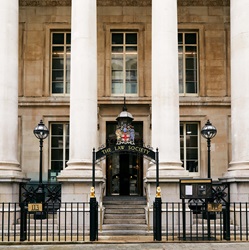
Law Society: All members will now get to vote
The Law Society leadership yesterday lost the vote on its bid to increase the threshold for calling a special general meeting (SGM) – and then immediately triggered a ballot of all members.
The motion at the annual general meeting to raise the number of signatures [1] required to call an SGM from 100 to 0.5% of the membership – or 1,080 on a current membership of around 216,000 – was defeated by 72 votes to 67 (52% to 48%).
President Richard Atkinson immediately invoked the society’s bye-laws to call for a vote of the whole membership given how close it was – although most of those voting in favour were likely to have been members of the ruling council, which had met earlier in the day and in whose name the motion was laid. It has 97 members in total.
The Law Society said the ballot would cost less than £10,000.
The only speakers during the meeting in favour were current council members, plus one ex-member, while 2010 Law Society president Linda Lee and former long-serving council members Michael Garson and Sara Chandler were among the larger number who spoke against.
Ms Lee questioned the claim that SGMs cost the society £100,000 or more. She described this as a “theoretical accounting cost for the large part”, because the building and staff “are already here”.
“Council has to be confident that its views can be challenged,” she said, adding that the change would “effectively stop” SGMs. This was “not necessary or proportionate”.
There was an SGM called last year for a motion of no confidence [2] in the society’s leadership over its handling of the TA6 conveyancing form. While it failed, Ms Lee said it had ultimately “worked” by leading to the Law Society changing its approach.
Mr Garson, a one-time Law Society treasurer and board member, agreed with this analysis and argued that trust was built “on transparency and respect”.
He complained that the workings of the society were not transparent – agendas and minutes of meetings, which used to be public, were not any longer, while the annual report before the meeting, for the 12 months to 31 October 2024, was a year out of date.
“You should be welcoming the engagement,” he told the council. He added that, with the Law Society spending £29m spent on staff, it should be able to absorb the costs of an SGM easily.
In putting the case for the motion, Melinda Giles, a member of both the council and the Law Society’s managing board, described it as “necessary, proportionate and overdue”.
The current threshold was set in 1975 when the society had 38,000 members. “It no longer constitutes a meaningful mandate – it’s become a loophole,” she said.
The society was “an outlier” compared to other professional bodies, Ms Giles went on, stressing that the move was “not a kneejerk response” to last year’s SGM. It was part of a broader governance update, she insisted.
But it had proven “trivially easy” to sign up 100 members last year, she noted – done within 24 hours.
The change was “not designed to prevent SGMs where there is genuine widespread concern”, but to stop the “diversion of resources by small groups”. There were other ways for such groups to engage with the society, including by bringing a motion at the AGM, which only required 30 signatures.
Vivien Stern, a past president of West London Law Society, argued that a 10-fold increase in the threshold was too much and twice as much as the increase in size of the profession since 1975.
It would be difficult to get an accurate number of how many signatures would be required to obtain 0.5%, as the number of solicitors was in constant flux, Ms Stern added.
Opponents also said that, despite social media, it would still be difficult in practice to gather 1,000 signatures.
An earlier amendment to the motion to allow 0.5% of a particular segment of members (eg, conveyancers or ethnic minority solicitors) to call an SGM was heavily defeated.
After the vote and Mr Atkinson’s call for a ballot of all members, confusion reigned over who would draft the 1,000-word opposing statement in the communication to solicitors about the vote.
Mr Atkinson initially suggested that all those who voted against the motion should collaborate, but Ms Stern warned that the odds of getting that many solicitors to agree on it were “zero”. He accepted her idea that those who had spoken against it should collaborate might be a better way forward.
Mr Atkinson then handed over his badge of office to Mark Evans, the 181st president but only the third from Wales. Now a lecturer at the University of Law, Mr Evans was previously a conveyancer.
Personal injury lawyer Brett Dixon has moved up to vice-president, with Dana Denis-Smith – founder of alternative legal services provider Obelisk Support – becoming deputy vice-president.
The AGM saw the election of council members for 29 constituencies but for two others – Shropshire & Herefordshire, and Lincolnshire – there were no nominations received and the local law societies had not subsequently been able to find anyone either.