


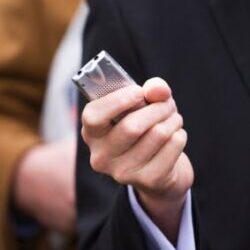
Recording: Doctor inadvertently made on of his own
A solicitor was “quite wrong” to advise his personal injury client to make a covert recording of testing undertaken by their opponent’s medical expert, the High Court has ruled.
This was particularly the case as the parties had agreed not to record each side’s testing, which the solicitor said he had forgotten.
His Honour Judge Shanks, sitting as a High Court judge, was ruling on an application in a £3.25m claim by a passenger in a road traffic accident.
There was no issue that the accident has had severe effects on the claimant’s functioning but there was a question as to whether she suffered a traumatic brain injury or whether the effects of the accident were non-organic and therefore psychological or psychiatric. The trial of quantum is set for next February.
The application was for the claimant to rely on her covert recording of neuropsychological testing carried out by Professor Gus Baker earlier this year, and on a report on the way the tests were administered prepared by her expert.
Before a case management conference in February 2024, counsel for each side had agreed that the testing section of the parties’ neuropsychological assessments would not be recorded, and the master “expressed satisfaction with that outcome”.
The claimant’s solicitor, named only as Mr Dickinson, accepted that he authorised the agreement.
“However, his evidence is that he had forgotten about this agreement when, before the claimant was due to see Professor Baker on 19 March 2025, he advised her to record the testing covertly,” said HHJ Shanks.
The solicitor said he gave this advice because of his experience of other cases and “the danger as he perceived it of injustice resulting from unreliable test results being put forward on behalf of defendants”.
Professor Baker’s report included “a number of observations that were unhelpful to the claimant’s case”, the judge noted.
The claimant’s expert then produced a report that, based on the recording, raised a number of concerns about Professor Baker’s conduct of the test.
In deciding whether to allow the recording, HHJ Shanks said “the claimant, who is relatively blameless in all this, may find herself left with a justifiable sense of injustice if this evidence was excluded”.
But he went on: “Although I have no doubt that Mr Dickinson’s motivation was to help his client, who he considers deserving, and to prevent the potential injustice that he perceives from defence experts not doing their job properly, I consider it was quite wrong of him to advise his client to do what she did. I hope he will never do it again.
“The claimant personally was obviously doing what she was told or advised to do but nevertheless in my view she must, or should have, had misgivings about it.”
While the agreement not to make recordings did not amount to an undertaking to the court, it should not have been breached – and had it been deliberate, the evidence would “certainly not have been admitted”.
The judge added: “Trust between lawyers is essential to the running of this kind of litigation and there is a heavy public interest in upholding such an agreement. The way to do that would have been by preventing the claimant relying on the fruits of the breach.
“However, although it is surprising, I accept for the purposes of this application that Mr Dickinson genuinely forgot about the agreement and of course there is no suggestion at all that the claimant herself knew about it.”
What the judge found a “quite difficult” decision was tipped in favour of granting the application by the discovery that Professor Baker inadvertently recorded his testing of the claimant due to a feature in the software he used.
“If it is disclosable and was then disclosed, that would mean that even if the test process had not been covertly recorded by the claimant she would or should have been provided with a tape which could have been used for the very purposes her recording has been used.
“In those circumstances it does not seem to me it makes sense to prevent the claimant relying on her own tape and I would therefore allow that to happen.”
The remaining concern was that the tests undertaken by the claimant’s expert were not recorded. The answer was that they would be repeated and the tape provided to Professor Baker.
 Karl MH Liljenberg




I mean how obvious could this be. Even if there had been no prior agreement not to do it.I would still tell my client not to.