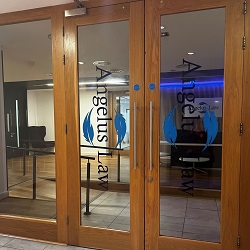
Angelus Law: Closed down after taking on HSS’s files
A law firm partner who failed to disclose to the Solicitors Regulation Authority (SRA) that her firm was facing a winding-up petition has been suspended for three months.
The sanction issued to Sarah Louise Kearney is the third to come out of the collapse of Liverpool law firm High Street Solicitors (HSS), which handled high-volume consumer claims.
Ms Kearney, who qualified in 2012, joined HSS in 2019 and at the time of the misconduct was one of two partners, alongside non-solicitor Thomas Hardwick. She was also the head of legal practice (HOLP).
The firm went into administration in June 2023 and was sold in a pre-pack to Angelus Law – which was then closed down by the SRA in April 2024.
According to a statement of agreed facts and proposed outcome, approved by the Solicitors Disciplinary Tribunal, the SRA received a complaint in February 2022 from an HSS creditor owed expert fees.
They had instructed a debt recovery agent to conduct background checks on the firm, which showed three unsatisfied county court judgments totalling £50,000, with a further 14 satisfied judgments worth £347,000.
An SRA investigations officer visited the firm in January 2023 and was reassured by Ms Kearney and Mr Hardwick that they had no concerns about the firm’s ability to meet its short-term liabilities, describing its financial issues as “mainly historic”.
At a further meeting in April 2023, Ms Kearney failed to tell the officer that the firm was actually facing serious financial difficulties – winding-up petitions had been served in October 2022 and March 2023 by a medical reporting agency.
The first was withdrawn after a payment plan was agreed, but only £100,000 of the £340,000 owed was paid.
Ms Kearney and Mr Hardwick had originally told the SRA that the firm had liabilities of £5.3m but before the April meeting revealed that actually they were £9.1m, with a further £17m in ‘funding arrangement borrowing’ which had also not been disclosed.
Ms Kearney later told the SRA that she had not deliberately failed to report the winding-up petitions. “It was just probably a lot going on at the time,” she said, insisting that she had been open and transparent during the investigation.
But, “with the benefit of hindsight and reflection”, she accepted that she had breached various rules in not disclosing material details relating to HSS’s business and financial management.
In recommending a three-month suspension, the SRA noted her experience, the fact she was the HOLP and the “several opportunities” she had to tell the SRA.
Her conduct “departed from the integrity, probity and trustworthiness expected of a solicitor,” it went on.
The tribunal said it was “an appropriate and proportionate sanction”.
In September, the SRA issued an order disqualifying Mr Hardwick from owning or working in law firms because he “intentionally failed to disclose all relevant information to the SRA throughout its forensic investigation”.
Victoria Powell, who was HSS’s head of finance and administration at the time, was similarly disqualified earlier this year.