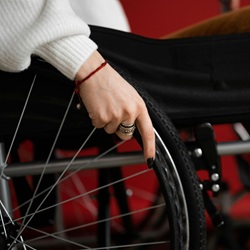
Wheelchair: Shaw stopped user moving away
A senior male lawyer made unwanted and inappropriate remarks and advances to five junior female staff at a work event and post-event drinks, the Solicitors Disciplinary Tribunal (SDT) has found.
Darren Shaw’s actions included restricting the movement of a wheelchair-bound colleague so she could not get away from him.
They represented “a failure to maintain appropriate professional boundaries, an abuse of seniority, and behaviour apt to cause offence, humiliation, and distress”, it said.
As Mr Shaw is a chartered legal executive, the SDT is unable to take disciplinary action against him but made him subject to a control order under section 43 of the Solicitors Act 1974.
This means he cannot work for a law firm regulated by the Solicitors Regulation Authority (SRA) without its permission.
However, CILEx Regulation has indicated it may now take action against him.
At the time of the events in October 2022, Mr Shaw was head of financial products at class action law firm Keller Postman, now part of KP Law.
It was the firm’s all-staff annual conference and dinner in Manchester. The evening included a raffle of which one of the prizes was a ‘Virgin Experience Day’. When it was announced, Mr Shaw made a comment about winning a night with ‘Person A’.
Person B said he implied Person A was a virgin and that the winner could take her virginity.
Person E, who was in a wheelchair, said Mr Shaw later approached her, took her hands uninvited and tried to move her onto the dancefloor, controlling the chair so she could not move away.
She stated that Mr Shaw did the same again later; she repeatedly said she did not want to dance but he replied “Oh stop, you’re teasing me”.
Person B said Mr Shaw approached her while she was wearing a hat, adjusted it to show more of her face, telling her she had “a great face”.
Person D stated that Mr Shaw approached her “uninvited and out of nowhere,” leaned close to her ear and said words to the effect of “do you want to come to the bar alone with me?”.
After the evening ended, a group went on to a bar, at which Person B said Mr Shaw asked: “Has anyone ever told you you’re beautiful, gorgeous, really attractive?”
Person D said he moved close to her, put his arm around her back, and placed his hand on or near her waist. He then remarked “you smell like coconuts” and asked if she was married or single, adding she was “too pretty to be single”.
Further comments included “you have really nice eyes” and “oh what I’d do to you with those eyes”. As she moved away, “she felt Mr Shaw’s hand on her waist drop to on/near her lower back for a few seconds in what she described as a ‘stroke’ motion”.
Person C said she initially agreed to dance with Mr Shaw, but he tried to stop her leaving, including moving his hand “to the front of her stomach and/or the top of her leg in a motion akin to rubbing”. A colleague intervened and pulled Person C away.
After receiving complaints about his conduct, Keller Postman appointed fellow law firm Gowling WLG to investigate.
This led to disciplinary proceedings and a first (and final) written warning. The firm also imposed conditions on Mr Shaw that prevented him from drinking at work or work events, attending its offices and/or events outside of Manchester without written approval, and “functional and hierarchical isolation from female staff in offices other than Manchester”.
Mr Shaw did not engage with the proceedings and did not dispute the factual allegations. However, the SDT recorded an email he sent in January that claimed there was “a corral of people in Birmingham office encouraging each other to make wild assertions without evidence after the event”.
He said he was told that the management team had seen no issues at the event and that the investigation was just a “process to be followed”.
“My employer saw no reason for me to be dismissed, and I remained with the firm; CILEX saw no case to be pursued but the SRA believed there was an investigation.
“Everything was settled with my employer and CILEX – my regulator – the SRA referral was a ‘paper exercise’ and the compliance officer at Keller Postman reached out to apologise because this was not the firm’s intention or requirements.”
Nevertheless, the SDT found the allegations proven and that some of Mr Shaw’s actions were “sexually motivated”.
His misconduct was “serious and wholly inconsistent with the standards expected of an individual involved in legal practice”, especially one in a senior position who “was perceived as having authority over junior colleagues”.
The tribunal continued: “The proven misconduct involved unwanted and inappropriate sexualised remarks and/or advances, and unwanted physical contact and coercive behaviour, directed at more than one colleague.
“It included behaviour towards a wheelchair user which restricted her autonomy and ability to move away.
“The tribunal accepted that Mr Shaw did not desist when objections were made or when discomfort was apparent, and that the power imbalance made it more difficult for junior colleagues to challenge his behaviour at the time.”
The SDT was satisfied that Mr Shaw’s conduct “amounted to an abuse of his position and harassment”, meaning it was “undesirable” for him to be involved in legal practice without the prior consent of the SRA.
This was particularly so given the comments made in the email, which indicated that Mr Shaw “failed to recognise the seriousness of his misconduct”.
He was also ordered to pay costs of £20,670.
In a statement, CILEx Regulation said: “There is a CILEx Regulation investigation into Mr Shaw’s conduct. The investigation began in 2023 after the SRA commenced its investigation into his conduct. Our investigation was placed on hold pending the outcome of the SRA’s.
“We have been in regular contact with the SRA and are aware of the section 43 order. Mr Shaw has also been made aware of our investigation and we will be contacting him again shortly to progress the case to conclusion.”
Though the SRA has the power to impose section 43 orders of its own volition, its agreement with the SDT is that cases involving allegations of sexual misconduct should still typically be referred to the tribunal.