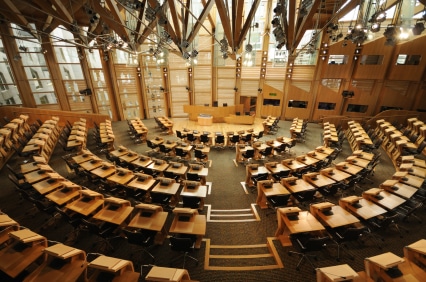
Scottish Parliament: amendments to come during next stage of bill
The council of the Law Society of Scotland has today ditched its support for all forms of alternative business structures (ABSs) and instead backed a compromise that favours majority ownership of law firms remaining with solicitors, or solicitors with other regulated professionals.
The decision of the society’s council took account of a recent referendum on ABSs and a special general meeting, which produced contrasting results, with one in favour of ABSs and one against (see story). At the SGM, members voted against this very compromise, however. The new position will be put to the society’s AGM in late May.
Earlier this week, the Scottish Parliament’s stage 1 debate on the Legal Services (Scotland) Bill – which had been delayed so that the result of the SGM could be considered – gave cross-party support to the introduction of ABSs in principle, while agreeing that amendments were needed at stage 2 to address a number of concerns. Minister Fergus Ewing noted that “many of the arguments that have been put forward by those who oppose the bill have been misinformed, exaggerated or downright misleading”.
Ian Smart, the Law Society of Scotland’s president, said that while there are strong differences of opinion about the way forward, “there does, however, seem to be an acceptance that ABSs are inevitable, as reflected in the parliamentary vote, and that a compromise must be found”.
He continued: ”With that in mind, the society’s council – which includes solicitors from every sector of the profession – has adopted what it believes to be fair and reasonable compromise position, which would prevent outright external ownership, for instance by supermarkets, but allow firms to compete in a changing marketplace. All attempts to compromise were rejected at the SGM earlier this month. However, that vote was based on proxies granted before any compromise had been proposed.”
Mr Smart said that while the Scottish profession should have the chance to express “an informed view on whether this compromise policy is acceptable”, the next stage of the parliamentary process will occur shortly, “so the need to present a clear council policy without further delay was uppermost in the minds of council members”.
Meanwhile, also during the Scottish Parliament debate, Mr Ewing indicated that amendments would be introduced at stage 2 of the bill concerning the regulation of non-solicitor will-writers.