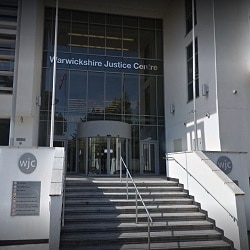
Warwick Crown Court: Conviction upheld
A man convicted of rape has lost an appeal against conviction that was based partly on the fact that his solicitor was facing disciplinary action by the Solicitors Regulation Authority (SRA) at the time.
The Court of Appeal found that the ultimate decision to strike-off the solicitor-advocate – for dishonestly dealing with client funds – was irrelevant to his representation of Craig Lea.
It also rejected Mr Lea’s claim that he had been put under improper pressure by the solicitor to plead guilty.
In the ruling, delivered by Mrs Justice Thornton, the solicitor is referred to simply as Mr Haddock, saying he was struck off on 31 July 2023.
That is the day of the written reasons given by the Solicitors Disciplinary Tribunal for its decision in June to strike off Christopher Michael Haddock, then a 72-year-old solicitor, who borrowed £25,000 from a client to help prop up his Halifax-based firm and then tried to hide it from the SRA as fees paid on account.
On the morning of his trial on 14 September 2022, Mr Lea had changed his plea to guilty of rape. Three months later, represented by new counsel, he applied to vacate it on the basis he had been placed under significant pressure to plead guilty by Mr Haddock.
Thornton J said the judge, His Honour Judge Peter Cooke at Warwick Crown Court, refused the application. “The judge acknowledged Mr Haddock’s unconventional approach towards client care, but considered those matters were not particularly relevant to the issues in the application.
“It was apparent there had been a lack of professionalism and that Mr Haddock had departed from best practice by failing to obtain an endorsement of his brief or to make any form of contemporaneous note of the applicant’s decision to change his plea on the morning of the trial.”
But HHJ Cooke found that Mr Lea “would have been aware of the significance” of a recording of the encounter with the victim, while his mother, “a truthful witness”, recalled the circumstances in which her son told Mr Haddock he would plead guilty.
Thornton J went on: “Having heard him and Mr Haddock give evidence, the judge regarded it as inconceivable that the applicant – an articulate, intelligent businessman – would simply bend to the will of Mr Haddock.
“The change of plea was a grudging capitulation to the reality of the case. The applicant was not overborne by pressure from his advocate to change his plea.”
Mr Lea was subsequently sentenced to 62 months’ imprisonment.
One of Mr Lea’s grounds for appeal was the conduct of Mr Haddock, who was facing disciplinary proceedings at the time. The single judge refused permission to appeal on the papers, noting that the evidence of the solicitor being struck off was legally inadmissible in the criminal proceedings and, in any event, irrelevant.
The single judge said: “Mr Haddock was struck off for dishonestly dealing with client funds, which has (as a matter of fact, as well as law) no relevance to the issues in this appeal.
“The judge, who heard all the relevant evidence on the application to vacate, accepted that Mr Haddock’s approach was unconventional and, at times, not best practice (e.g. in that he did not make an endorsed brief note in relation to the change of plea), and took those matters fully into account when considering the determinative issues in the application to vacate.”
Thornton J said: “We agree with the single judge. Whilst unfortunate, the misconduct of Mr Haddock is not relevant to the criminal proceedings, as to which the core issue was consent.”
The Court of Appeal also rejected the submission that Mr Haddock put Mr Lea under improper pressure to plead guilty.
The single judge found Judge Cooke had applied the right legal test, considered the evidence “with patent care” and was “clearly entitled” to conclude as he did.
Thornton J said: “Having watched the video, we agree with the judge that the decision to change plea was consistent with a pragmatic decision by the applicant to accept the reality of the evidence against him.”