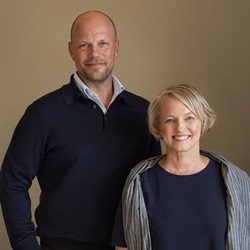
AGRD: Björn Larsson and Maria-Pia Hope
Private equity in the law expanded to Sweden yesterday with the launch of AGRD Partners, a new group formed by six firms and backed by a Nordic investment house.
Allié, Born, Morris Law, Next, Synch and TM & Partners make up the group and together have around 250 professionals across eight offices.
AGRD, backed by private equity firm Axcel, is now one of the top 10 legal businesses in the country by revenue. It plans to grow both in Sweden and internationally.
Swedish law firms are prohibited from accepting external capital and so the lawyers at each firm who are currently members of the Swedish Bar Association – which regulates individuals, not firms – will have to resign their membership.
This means they cannot call themselves an ‘advokat’, the professional title for lawyers in Sweden. AGRD’s lawyers will instead comply with a code of conduct developed by the group.
Each firm will retain its name and continue operating independently, but joint initiatives on technology, skills development and new client offerings will be carried out through AGRD.
With offices in Copenhagen, Stockholm and Frankfurt, Axcel invests across Northern Europe and has raised seven funds with committed capital of more than €4.3bn (£3.7bn).
A central management team and board for AGRD are being formed, and its chair is Maria-Pia Hope, former managing partner at top Swedish firm Vinge, who advised Axcel on the investment.
She said: “Business law continues to rely on traditional structures and established ways of working. While there is clear potential to generate business value through smart collaboration and new technology, the industry remains conservative, with tradition often taking precedence.
“AGRD Partners brings together leading business law firms with a strong focus on innovation, aiming to narrow the gap between client needs of the future and what the market typically delivers.”
She added that the decision to leave the bar association “does not reflect any criticism and is solely a result of Swedish regulatory requirements”.
Axcel partner Björn Larsson said: “With AGRD Partners, we see an opportunity to shape the future of business law in Sweden and beyond.
“There is a growing international trend of external capital and new strategic ownership reshaping and strengthening the legal sector, much like developments in the audit sector. By bringing together several of Sweden’s top business law firms and enabling substantial structural investments, we are creating a powerful partnership with the potential to transform the business law landscape in Sweden.”
Meanwhile, the world’s largest litigation funder, Burford Capital, has made headlines by telling the financial press that it is looking to take equity stakes in US law firms.
In 2020, it took a minority stake [1] in a London law firm, now called PCB Byrne, in return for providing finance, although Burford has not done any other deals in the UK since, despite expressing its desire [2] to do so.
Chief executive Chris Bogart has also accused the Solicitors Regulation Authority of squandering the opportunities [3] presented by alternative business structures (ABS).
Arizona was the first and so far only US state to permanently ditch the ban on non-lawyer ownership of law firms and would be one option.
In February, Arizona licensed KPMG Law US [4] to become the first law firm in the US owned by a Big Four firm and has now licensed around 120 ABSs, including some that also have ABSs over here, including alternative legal services providers Elevate [5] and Axiom [6]. Earlier this year, it granted a licence to a foreign law firm [7] for the first time.
Utah began a regulatory sandbox that allows ABSs in 2020, but changed its rules last year so that an applicant must show that authorisation would allow it to reach Utah consumers currently underserved by the legal market. Puerto Rico is moving towards allowing ABSs.
The other option Burford is examining is management services organisations (MSOs), which have long been used in healthcare in the US.
US firm Holland & Knight says it has already closed “multiple private equity investments into MSOs that support law firms and also helped restructure law firms that are interested in courting investment”.
In a briefing on its website, it explained that the MSO acquires substantially all of a firm’s assets – except any that must be owned by a law firm, such as client records – and enters into a long-term contractual agreement with the firm, “while preserving and safeguarding the independence of the law firm entity and its lawyers”.
Due to rules that prohibit lawyers sharing fees with non-lawyers, the fee the law firm pays the MSO for its services generally cannot be a percentage of revenue.
Holland & Knight said the structure was largely untested from a regulatory point of view, although earlier this year the Texas Commission on Professional Ethics ruled that, while a lawyer may not pay an MSO a fee based on a percentage of the law firm’s revenues, a lawyer could own equity in an MSO with non-lawyers that provides support services to law firms.