


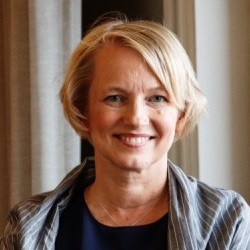
Hope: Independence with collaboration
A private equity-backed group of law firms in Sweden has already had interest from UK practices as it looks also to expand across the Nordic region, its chief executive has revealed.
Maria-Pia Hope of AGRD Partners said the offer of retaining a large degree of independence was appealing to the UK market.
Allié, Born, Morris Law, Next, Synch and TM & Partners made up the group when AGRD launched last summer – with around 250 professionals across eight offices between them – and at the start of this year Wigge and Bokwall Rislund joined to make eight members.
Ms Hope – former managing partner of top Swedish firm Vinge – told Legal Futures that the group was now the fifth largest legal services organisation in the country.
AGRD is backed by Nordic private equity firm Axcel but as Swedish law firms are prohibited from accepting external capital, the lawyers at each firm have had to resign their membership of the Swedish Bar Association, which regulates individuals, not firms.
This means they cannot call themselves an ‘advokat’, the professional title for lawyers in Sweden. AGRD’s lawyers instead comply with a code of conduct developed by the group.
Ms Hope said that, taken together, the Nordic countries have the 11th largest economy in the world and a lot of trade and investment flowed between them. This made them an attractive market.
The AGRD model is “built on joining forces and collaborating a lot, but individual firms retaining their independence to a large degree”, as well as their brands, she said.
“We think that works really well in a professional service context, where my experience is that individual partners often want that sort of freedom in order to develop their businesses and client relationships.”
The role of the central team she heads “is to make sure that they have the support they need in order to excel, to grow and to improve their market position even further”.
Axcel has a majority stake in the firm but their partners have also reinvested in the central group. “So there are incentives to work together to make sure that this group thrives,” she said.
The challenge faced by a lot of mid-sized law firms of figuring out “how to get your arms around the rapid development in AI and legal tech” was a key driver in the group’s creation, Ms Hope continued. This was not just the capital but also the expertise.
“Firms are thinking a lot about this and they can see that it makes sense to join forces, quite simply.”
AGRD’s initial focus is on expanding into the other Nordic countries. “There’s been a large amount of interest from the rest of Nordics. We are hopeful that we’ll be able to do a couple of transactions in the not-too-distant future.”
It will then look further afield, with England and Wales top of the wish-list – both because it is the largest legal market in Europe and also that the regulatory framework “makes it easier to invest”.
Ms Hope went on: “Looking at investment opportunities in the UK is something we are slowly starting to do. It’s obviously a very large market, one that we really have to navigate carefully so as to get the right firms in.
“But we’ve had a lot of interest already. I think the Nordic model that we are offering… is appealing. That’s at least what we are hearing. And so we’re certainly hopeful that we’ll be able to make investments in the UK as well in due course.”
The lawyer believed that “the tide is turning” on non-lawyer ownership of law firms across Europe, where it is banned except in Germany, where lawyers can go into partnership with certain other professions.
“There are challenges that are present in pretty much every country, and especially in smaller/mid-cap segment of the legal market, where there are a lot of really good, entrepreneurial firms.
“So the combination of external capital and external expertise helping to address the challenge is potentially appealing in quite a lot of places.”
Ms Hope said the fact that AGRD lawyers were no longer members of the Swedish bar had not proven a barrier.
“The analysis was that client relationships are built on trust – knowing your lawyer, knowing their competence and knowing that’s the person you want to turn to. So the loss of clients for the firms that have exited the bar association has been extremely minimal.” Rather, media coverage has attracted clients to the group.
She added that Nasdaq Stockholm, the Swedish stock exchange, had changed its rule that only bar association members could work on listings so that AGRD firms could continue to advise on them.
“They welcomed increased competition, but for them it was important that we had a code of conduct and that we were committed to continue to apply the high standard of ethics in our relationships with clients.”











