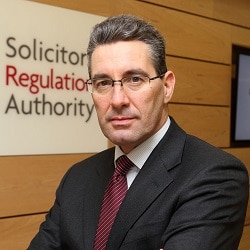
Philip: It’s been a privilege
Paul Philip is to retire from the Solicitors Regulation Authority (SRA) towards the end of 2025 after nearly 12 years as chief executive, it announced this morning.
He will leave the regulator he joined in February 2014 once a replacement has been found.
Deputy chief executive Juliet Oliver announced last month that she was leaving too to become head of Stratify, a strategic regulatory advice service for the legal sector set up by City law firm Kingsley Napley.
Along with chair Anna Bradley, Mr Philip has been under significant pressure since publication of the Legal Services Board’s report on Axiom Ince last year, which found the SRA “did not take all the steps it could or should have taken” ahead of the firm’s collapse.
However, both have repeatedly brushed off calls for them to resign – indeed, they refused even to apologise to the profession. The SRA is braced next for a follow-up review of how it handled the collapse of SSB Law.
Mr Philip, who is 62, said: “It has been a privilege to be able to play such a key role regulating in the public interest. It has been an incredibly interesting, challenging and fulfilling role.
“I would like to thank all my colleagues in the SRA, as well as the SRA board – all of whom are united in delivering in the public interest. Both their support and challenge throughout the years has been invaluable.
“Likewise, I would also like to thank all those outside the SRA – both within the profession and beyond – who have worked with me, shared their thoughts, and sharpened my thinking.
“There is always more you would like to do and achieve, but I am proud of the progress we have made. After so long at the helm, this feels like the right time to retire and switch pace.
“But before then, there is a lot of significant work to progress. I then look forward to handing over to a new chief executive later in the year.”
Ms Bradley praised Mr Philip for leading the SRA “through transformative change”.
She went on: “When he took over, the SRA was still very much embedded in the Law Society governance structures. He has helped us negotiate our way through to becoming a separate legal entity, significantly improved our operational processes, and ensured we became a more efficient and effective regulator.
“The SRA is mid-way through its current strategy and last year strengthened its senior management structure, making this a good time for succession to occur…. He will be a hard act to follow.”
Last year, the SRA board chose to extend Ms Bradley’s six-year tenure by two years because this was “not a steady state period for the SRA”.
Law Society chief executive Ian Jeffery said: “I would like to pay tribute to Paul’s personal contribution to the regulation of the solicitors’ profession in England and Wales over the last 12 years.
“He has led the SRA to a position where it now operates wholly independently of the Law Society and he has achieved much in his time. While the Law Society and the SRA will not always agree, I am grateful for the professional way he has engaged with us.
“Paul’s departure this autumn comes at a critical time in the history of the SRA. The hard lessons for the SRA from the Axiom and SSB collapses will require a period of deep reflection and significant organisational change.
“The handover to a new leader will be crucial to how the SRA moves forwards.”