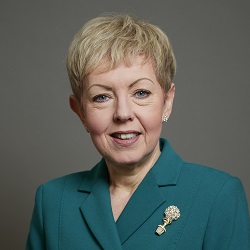
Stowell: SLAPPs are a stain on our legal system
The second of two private members’ bills to introduce an anti-SLAPPs law will be introduced in the House of Commons today in a bid to pressure the government to act.
The bill promoted by Sir John Whittingdale MP follows one given its first reading in the House of Lords yesterday after being introduced by fellow Conservative Baroness Stowell.
The UK Anti-SLAPP Coalition described the moves as “a rare demonstration of cross-chamber solidarity and pressure, signalling the mounting demand for stronger protections against this abuse of the legal system after repeated delays in government action”.
A previous private members’ bill introduced in the last Parliament by a Labour MP won government support – the only way such bills can become law – but it ran out of time before the 2024 election.
Though Labour has pledged to take more action to curb strategic lawsuits against public participation (SLAPPs) – there are provisions in the Economic Crime and Corporate Transparency Act 2023 but these only apply to cases relating to economic crime – it has not yet done so.
Baroness Stowell’s two-page bill seeks to introduce the right for a person facing abusive legal action to apply to have the case dismissed at an early stage, with a court ruling on whether the public interest of free speech outweighs the likely success of the claim of harm or damage.
She described this as “a simple filter mechanism that is fair to both sides”.
If the court dismisses the action as a SLAPP at this point, the claimant would have to pay the defendant’s legal costs.
If the court rules the case can proceed, the defendant would have costs protection unless the court determines a costs award is just and appropriate in all the circumstances.
The bill is intended to give protection against abusive legal action without having to explicitly define a SLAPP or ask the court to make a judgement on the motivation of the claimant.
Baroness Stowell said: “The attack on free speech represented by SLAPPs is a stain on our legal system and a threat to a functioning democracy. For too long British courts have been used to hush-up unethical behaviour and corporate abuses…
“While some protection against SLAPPs was introduced in the last Parliament, it only covers economic crime, is still too costly for those on the receiving end and relies on them having to prove malicious intent by the party bringing the legal action.
“That is too high a bar to overcome. My new bill will level the playing field and ensure fair treatment for both sides in a legal dispute: legal abuses can be swiftly thrown out without preventing access to justice for legitimate claims.”
The peer added: ““We must end abusive SLAPPs. My bill is an opportunity to do that. I hope the government recognises that and supports its passage.”
Susan Coughtrie, a co-chair of the UK Anti-SLAPP Coalition, said the bills offered the chance to turn support for addressing SLAPPs “into robust, accessible and universal protections for everyone, ensuring justice is available to all, not just those who can afford it”.
The Media Lawyers Association has been advising on both bills. Chair Pia Sarma said the bills put forward “a simple and fair system”
Both bills will receive a second reading, expected to take place after the Parliament’s summer recess.