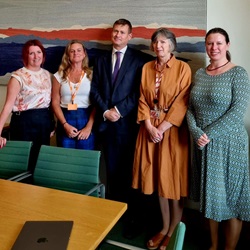
Meeting: (l-r) Louise Haigh, Zelda Perkins, Justin Madders, Frances O’Grady, Sarah Russell
The government is to ban non-disclosure agreements (NDAs) covering harassment and discrimination unless the victim themselves asks for one.
Last night it laid an amendment to the Employment Rights Bill currently going through the House of Lords that provides that an agreement between an employer and a worker that purports to prevent the worker making an allegation or disclosure of information relating to certain work-related harassment and discrimination is void.
According to anti-NDA campaign group Can’t Buy My Silence (CBMS), this means the new law will also apply to ‘non-disparagement’ clauses that can be used to prevent individuals from speaking about misconduct, “thus closing a common legal loophole used to suppress victims”.
The misuse of NDAs is one of the issues commonly cited when concerns about lawyers’ ethics have been raised in recent times, including by the Legal Services Board.
CBMS’s four-year campaign – led by Zelda Perkins, the woman who famously first broke a Harvey Weinstein NDA – has been strongly backed by Labour MP Louise Haigh, and both met with employment rights minister Justin Madders yesterday along with employment lawyer turned MP Sarah Russell and Baroness Frances O’Grady, former general secretary of the TUC.
CBMS said that, although the detail would be in forthcoming regulations, the government has committed to consultations ensuring that any confidentiality clause must be: at the request of the victim with no undue attempt to influence and after receiving independent legal advice; the agreement can be time limited and have a cooling-off period; and victims will always be able to speak to certain prescribed individuals.
Writing on X last night, Mr Madders said: “Really pleased that we are legislating to ensure that victims of harassment and discrimination will be able to have their voices heard in future so that unacceptable behaviour at work can be challenged instead of being hidden.”
Ms Perkins said: “This change has been a very long time coming. For every person who has spoken out, despite fear, legal threats, or personal cost – this is proof that your voice made a difference.
“Confidentiality clauses have been used to cover up harassment and discrimination for decades. Finally, the government is acknowledging the harm they cause, not just to individuals, but to entire workplaces.”
Ms Perkins added that she would continue working with Ms Haigh to ensure the regulations that follow “are watertight – and that Labour follows through on its promises”.
Ms Haigh described the decision as “an incredible victory for victims and campaigners”. She went on: “[It] will mean that bad employers can no longer hide behind legal practices that cover up their wrongdoing and prevent victims from getting justice.”
CBMS also praised the “tireless work” of former Conservative MP Maria Miller – who as chair of the House of Commons’ women and equalities committee strongly pushed for action on NDAs – and Liberal Democrat MP Layla Moran.