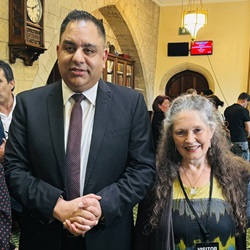
SSB concerns: Imran Hussain MP with Debra Sofia Magdalene, pictured at a meeting earlier this year
MPs whose constituents have been badly affected by the collapse of SSB Law have pledged to lobby the new government to take action against lawyers and others.
A meeting in Parliament yesterday involving several MPs, representatives of victims and other interested bodies also highlighted concerns over use of the phase ‘no win, no fee’, which many felt was misleading.
It was organised by Imran Hussain, the Labour MP for Bradford East, who is currently sitting as an independent after the whip was withdrawn for six months because he voted to scrap the two-child benefit cap.
Mr Hussain also this week put down an early day motion, which has so far attracted 18 other MPs’ support, highlighting the importance of home insulation measures but noting the “devastating consequences” for people where cavity wall insultation (CWI) has not been properly installed.
The motion “notes the previous lack of government action on this issue; notes with concern that legal firms that took advantage of residents with nowhere else to go for redress and then went into administration due to mounting conditional fee agreement case debts”.
It calls for an immediate investigation into how residents “have been left with crumbling homes and legal bills stretching into the tens of thousands”, and for the government “to investigate the role and conduct of legal firms involved”.
SSB went into administration in January owing six litigation funders £200m. Its indebtedness has since risen to £221m and the Legal Services Board is probing the Solicitors Regulation Authority’s (SRA) actions in the lead-up to the collapse of the group.
The focus is on failed claims over the defective installation of CWI that SSB ran where the after-the-event insurance it put in place is being repudiated, leading to successful defendants and their insurers seeking to enforce substantial costs awards against clients.
Mr Hussain led activity over CWI claims and SSB Law earlier this year but, with a new government, is having to start afresh.
Much of the focus of the meeting was on home insulation and the damage that faulty CWI had wrought and Debra Sofia Magdalene, an administrator of the SSB Victims Support Group, spelt out the huge impact these failures were having on members.
She went on: “We’ve got legal firms like SSB Law that exacerbate the problems through negligence, leaving victims in legal limbo. The government’s failed to support these victims in holding responsible parties accountable.”
Ms Magdalene said she did not know why the government was waiting for the outcome of the SRA’s own investigation into what happened, saying “that is not going to tell us anything we don’t already know – we need action now”. Mr Hussain said he had not heard from the regulator.
She called for direct government intervention in repairing and restoring damaged homes, arguing that as government had promoted these energy-saving schemes, it had an obligation to act. There also needed to be regulation of such schemes in future.
“On the legal side, we need to ban this term ‘no win, no fee’ because it’s very misleading. We need fair practices to ensure that homeowners aren’t trapped by legal and financial costs due to negligent work.”
Steve Playle, a Trading Standards manager for the City of London Corporation, said he had a “real bee in my bonnet” with ‘no win, no fee’.
“There is no such thing. This is the scandal now and I think the next [‘no win, no fee’] scandal will be diesel emissions claims. That’s just a bubble waiting to burst.” Other speakers also questioned the validity of the ‘no win, no fee’ label.
Mr Hussain concluded the session by stressing that MPs would “continue to raise this through all parliamentary channels”.