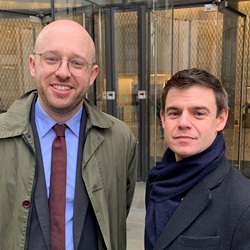
Lloyd Hatton (l) and Phil Brickell
Moving the supervision of lawyers’ anti-money laundering (AML) activities to the Financial Conduct Authority will strengthen the fight against fraud, a campaigning MP has told Legal Futures.
Phil Brickell, who chairs the All-Party Parliamentary Group on Anti-Corruption and Responsible Tax, was speaking to us during an event held this week by the group, together with the UK Anti-Corruption Coalition, to coincide with publication of the government’s Anti-Corruption Strategy.
The Labour MP for Bolton West said he supported the Treasury’s decision in October to move all supervision of lawyers and accountants to the Financial Conduct Authority (FCA).
“If you are a bad faith actor who wants to launder your gains behind that veneer of respectability, you will exploit the weakest chink in the UK economy’s armour. And we know historically that there have been inconsistencies in the AML supervisory approach, whether that’s in law, whether that’s in accountancy or elsewhere in the financial services sector.
“It’s right that people have a regulator that sits in the FCA to supervise the entire approach around ‘know your customer’ checks, around due diligence and around making sure that the AML regulations are kept to.”
As to whether the FCA would do a better job than the legal regulators, he said: “I don’t want to play regulators off against another one, but certainly my engagement having worked in the banking sector tackling financial crime for more than a decade is that they [the FCA] know the typologies well.
“Of course, there needs to be a period of handover from the legal sector and that’s going to take time. But it’s right that you’ve got that expertise housed in one place because you have an issue at the moment because you have such proliferation of supervisors that there are inconsistencies in intelligence sharing and in approach.”
The event talked more broadly about the use of the English courts and English lawyers by oligarchs and others, such as with SLAPPs (strategic lawsuits against public participation).
Mr Brickell acknowledged that people deserved legal representation but said lawyers still had to meet their professional obligations.
“Some of the examples we’ve heard today are egregious cases of how individuals have decided to use the English courts despite there being very tangential connections to the UK to litigate and to bully and intimidate those who would seek to scrutinise them.
“There may be instances where lawyers are put in an invidious position, but I think the examples we’ve heard of so far show how the law does need to catch up with some bad-faith actors who wish to use the English legal system as a shield and as a sword to attack those who quite rightly want to exercise their freedom of expression and a right to criticise those who they disagree with.”
The MP said the UK was “quite rightly proud” of its professional services sector. “But at the same time, we need to make sure that it’s a clean economy on which the foundations of growth are built. And law firms have got a vital part to play in that.”
Another MP at the event, Lloyd Hatton, focused his comments on SLAPPs and told Legal Futures that there needed to be “much more comprehensive and robust legislation” to deal with them.
The SRA needed to be “much tougher”, he said, “and they need to be enabled by legislation to be much tougher on this kind of thing”.
He went on: “I think the SRA understand the role that they have to play in making sure their profession operates in a principled and responsible way. But let’s not be in any doubt that it’s Parliament’s job as well.
“It’s Parliament’s job as well to put in place robust, clear legislation so things such as SLAPPs are a thing of the past in this country and we don’t see our courts used in a way that can stifle free debate, stifle scrutiny, and intimidate and exhaust those people who are choosing to speak truth to power.”