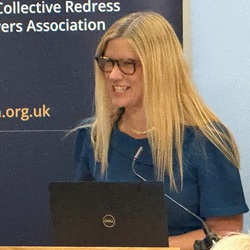
Reeves: Collective action has a significant role to play
Funders of collective actions should not be allowed to bring confidential arbitration proceedings against their clients, Walter Merricks – who brought the landmark Mastercard claim – argued last night.
He also revealed that he is set to take over as the class representative (CR) of another collective action.
At the same event, Solicitor General Ellie Reeves stressed the government’s strong support for collective actions, at a time when the Department for Business & Trade (DBT) is reviewing how the regime has gone in its first 10 years.
Earlier this year, Mr Merricks settled his one-time £14bn opt-out claim against Mastercard for £200m but this has triggered a major dispute with his funder, Innsworth Capital, which thought the sum too low.
It initially sought to bring a judicial review against the decision of the Competition Appeal Tribunal (CAT) to approve the sum – but has now shifted to challenging how the money will be distributed – and has started an arbitration under the litigation funding agreement against Mr Merricks.
In a bizarre twist, Mastercard has indemnified Mr Merricks to the tune of £10m in relation to the arbitration.
But Innsworth is seeking unlimited damages in the arbitration and so Mr Merricks applied to the CAT in August to be indemnified from the settlement sum. Instead, Innsworth provided an undertaking not to seek enforcement of any award beyond £10m.
Speaking at the event in London organised by the Collective Redress Lawyers Association, Mr Merricks revealed that, after six months of waiting for news on the judicial review, the court has decided to hold an oral hearing on permission in January or February next year, given the novel issues involved.
The money has still to be distributed, which Mr Merricks said was a huge frustration – and that it was therefore not a surprise that the CAT last week refused Innsworth’s bid to be paid the £46m in costs it spent in pursuing the case, before its return was considered. It is now considering another judicial review.
“One can only hope that some sense prevails in what has so far been a strategy and decision making of somewhat disastrous proportions… Innsworth is an embarrssment to the rest of the funding industry,” he said.
Mr Merricks, a solicitor, argued that “secret arbitration as a means of resolving disputes between class representatives and funders is totally unsuitable and should be prohibited”.
Without an indemnity like the one from Mastercard, CRs could find themselves in “extremely vulnerable” positions – and indeed, “no one can know if other CRs are now being improperly threatened” with arbitration.
“The proper forum for resolution of such a dispute is a public hearing before the CAT,” Mr Merricks said.
“The funder shouldn’t be to a threat of legal proceedings to improperly pressurise a class rep. If it has a good case that the class rep is about to breach the terms of the litigation funding agreement, it should be willing to allow the judge to consider it.”
This would “strongly incentivise” the parties to settle their dispute privately. “The CAT, in my view, should not approve any further litigation funding agreement at a certification hearing that provides for arbitration as the route for resolving disputes.”
Despite his experience, Mr Merricks said he was in talks to take over as the class representative of a collective action certified in 2022 against Govia Thameslink Railway over various excess fares it is accused of charging passengers on the London-Brighton mainline. The class representative, David Boyle, died in June.
In her address, Solicitor General Ellie Reeves spoke about her experience when practising as a solicitor representing large numbers of workers and about the “extraordinary impact of collective action, making access to justice possible for large numbers of people, even when individual claims may seem small”.
She said: “That to me, is the heartbeat of what you do. It’s slow. It’s often exhausting, but it’s absolutely transformative.
“[Collective redress] ensures that when wrong is done, people can come together, pool their strength and hold those in power to account. It’s about fairness, transparency and restoring public competence. That justice will not just be done, but will be done equally, whether you are an individual, a community, or a government institution.
“The rule of law for many can feel abstract, but the values are not – equality before law, fairness in process, protection from arbitrary power. These are not distant notions. They are lived necessities.
“This government will embed it in policy, in action, in outcomes that matter, and tell our shared story. Collective action has a significant role to play in that story.”
The DBT is currently reviewing the responses to its call for evidence on the regime.