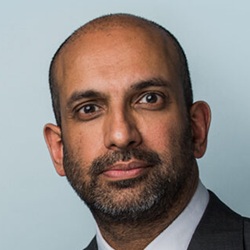
Menon: Lawyers did not comply with directions
The Court of Appeal has stayed the contempt hearing against KC Rajiv Menon so that the High Court can decide his challenge to its jurisdiction to hold it.
In a ruling on Friday ahead of the hearing that had been listed for tomorrow, Lord Justice Males said he and Mrs Justice Cutts did not have time “to consider in any detail whether the challenge which Mr Menon seeks to bring is arguable”.
“However, Mr Menon is represented by leading counsel and we are not in a position, without hearing argument (which there is no opportunity to do in the time available), to say that his position is unarguable.
“It appears to us that it may at least surmount the relatively low hurdle of arguability.”
As a result, “the general rule” – that jurisdictional challenges should be resolved before a defendant had to address the merits – applied, the judge said.
In January 2026, Mr Justice Johnson held that Mr Menon’s closing speech on behalf of a Palestine Action activist disobeyed his directions not to mention certain things, while expressly making no finding about whether that conduct was deliberate.
He referred Mr Menon to the High Court for possible contempt but the Court of Appeal set the order aside after finding that a Crown Court judge could not make such a reference directly to the High Court
However, the appeal court remitted the matter back to Johnson J to consider what other action he might take, having said a judge may refer a contempt in the face of the court to a High Court judge sitting as a judge of the Crown Court.
Last month, the judge decided that there was a case to answer in contempt and it went before Mr Justice Nicklin, sitting in the Crown Court, who issued a summons for Mr Menon to appear before Mrs Justice Cheema-Grubb on 28 July for a two-day hearing.
Males LJ said Mr Menon’s central argument was that the power for the Crown Court to institute summary proceedings for contempt was no longer available because it had to be exercised more or less immediately or not at all.
The earlier Court of Appeal judgment did not decide, and the court was not asked to decide, whether it was too late to exercise the power, he went on.
Mr Menon contended as well that a fair-minded and informed observer would conclude that there was a real possibility of bias and that Mr Menon would not receive a fair trial. The ruling did not explain the basis for this.
On 22 July, Cheema-Grubb J rejected an application to vacate the hearing, saying a bare assertion of a lack of jurisdiction did not justify doing so, but made it clear that Mr Menon could challenge her jurisdiction at the hearing itself.
Males LJ said this was understandable as it appeared she was not provided with the proposed grounds of appeal.
“Moreover, pursuant to her order of 9 July 2026, those representing Mr Menon should have submitted any jurisdictional objections by 16 July, but it appears that this was not done.
“If it had been, Mrs Justice Cheema Grubb would have been able to consider them before deciding whether to vacate the hearing or to direct that the jurisdictional objections should be dealt with as a preliminary issue.”
The Court of Appeal did not say when the jurisdiction challenge would be heard.
Supporters of Mr Menon have been increasingly vocal in criticising the contempt proceedings in the run-up to what they thought was the hearing.
Four chambers – Garden Court North, Garden Court, One Pump Court and Nexus – jointly hosted a webinar last week to express concern for and solidarity with Mr Menon at which various legal luminaries spoke.
They included Baroness Shami Chakrabarti, Lord John Hendy KC, Criminal Bar Association chair Riel Karmy-Jones KC and leading defence solicitor Gareth Peirce.
The event was sponsored by eight law firms: Bindmans, Bhatt Murphy, Birnberg Peirce, Deighton Pierce Glynn, ITN Solicitors, Kellys Solicitors, Hodge Jones & Allen and Robert Lizars Solicitors.
Solicitor Imran Khan wrote in The Guardian last week that “what is most fundamentally at stake is the constitutional value of fearless advocacy itself. The principle that counsel must be free to advance a client’s case without fear of personal retribution is not a professional privilege; it is a constitutional safeguard”.
A related petition addressed to the government asking whether “jurors have a right to acquit according to their conscience, even where a judge’s directions point toward conviction”, has attracted nearly 40,000 signatures.
Adrian Waterman KC and Anthony Hudson KC, instructed by Hickman & Rose, represented Mr Menon in the Court of Appeal.