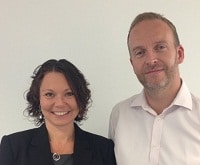
Tarrant and Gillespie: Combining expertise in Cognitive Law
Stuart Gillespie, founder of recruitment company G2 Legal, has set up a commercial law alternative business structure with his in-house solicitor, Lucy Tarrant.
They are partners in Cognitive Law LLP, which aims to recruit other lawyers to work as consultants on a fee-sharing basis remotely from locations across the UK.
In a statement, Cognitive said Mr Gillespie and Ms Tarrant would combine their “legal and commercial expertise” to form a niche commercial law firm.
The statement said Mr Gillespie was a “highly successful and entrepreneurial business owner”, and director of two companies which had grown substantially under his leadership – G2 Legal and Skillsearch, an IT recruitment specialist.
G2 Legal describes itself as one of the UK’s largest privately owned legal recruitment companies, with offices in Brighton, Birmingham, Bristol, Leeds, Manchester, London, Edinburgh and Glasgow.
Ms Tarrant is the COLP and COFA of Cognitive Law, which was awarded an ABS licence by the SRA last month.
“We are physically present in an office and people can see us there,” Ms Tarrant said. “But we can deal with things remotely and it’s not necessary for our consultants to be here if they don’t want to be.”
Ms Tarrant, formerly the in-house solicitor at G2 Legal, said Cognitive was still building its website, and only then could a recruitment drive begin, but this would happen before the end of the year.
“We have access to some superb candidates, but we haven’t put the feelers out yet,” she said.
Ms Tarrant, a partner at Sussex firm Mayo Wynne Baxter until October last year, said the process of obtaining an ABS license from the Solicitors Regulation Authority had taken only two and a half months – much quicker than expected.
She added: “I think ABSs will be embraced more widely so that lawyers can work more closely with business owners and be a lot more commercially orientated,” she said. “The way that technology has grown, there is no need for a business with everyone practising under the same roof.”
In the statement, Cognitive promised lawyers: “Consultants will be required to have their own significant client following, but that’s all they will need.
“Cognitive Law will provide them with full support including a cloud-hosted case management system so that they can work from anywhere at any time. Consultants’ compliance needs will be taken care of, as will billing and credit control. All a Cognitive Law consultant will need to do is what they’re good at – look after their clients’ legal needs.”