Law Society: Job description reveals internal changes
The Law Society is undergoing its latest internal reorganisation, with the aim of creating “the Future Law Society” by 2022, it has emerged.
It is also looking to help solicitors focus on work “that cannot be outsourced or automated”.
Not for the first time, details of Chancery Lane’s internal workings have come out in a job advertisement, rather than in active communications with members.
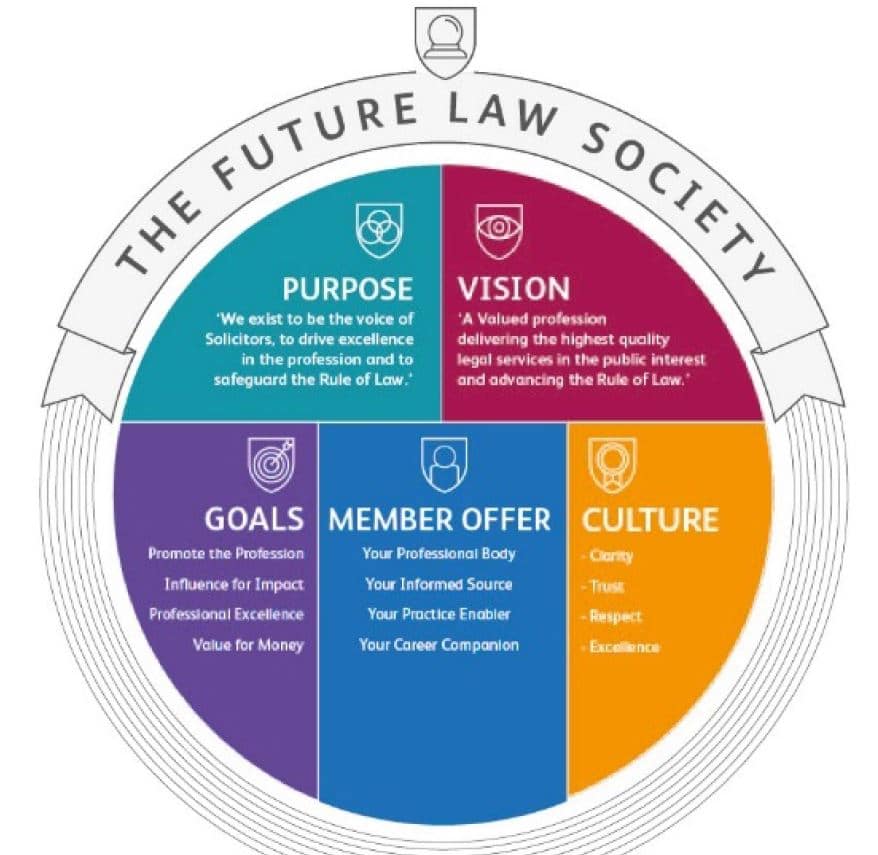
It included a graphic about the “Future Law Society” reproduced below.
The society is seeking an executive director for strategic insight and influence, who along with the chief operating officer and a new executive director of member experience will work under chief executive Paul Tennant to deliver its change programme.
In his introduction to the appointment brief, put out by external consultancy Saxton Bampfylde with no salary figure attached, Mr Tennant said that to “anticipate and respond” to the changing legal market, “we are changing too”.
He explained: “Over the last 12 months, we have made good progress. This includes refreshing the purpose and vision of the organisation, establishing goals and objectives to deliver our five-year corporate plan, and significant governance and culture changes.
“We have initiated our ‘Shaping Our Future’ programme, which contains three work streams focused on investing in technology, redefining our member offer and creating a vibrant workspace and engaged workforce.”
The brief said: “‘Member Experience’ will create a seamless, simple and personal experience for our members – no matter how, when or where they interact with us.
“‘WorkSmart’ will create a vibrant, professional and efficient working environment that allows us to work more flexibly, creatively and collaboratively together to deliver what our members say they need from us.
“‘IT Transformation’ will help us to embrace new technology and software to improve both the staff and member experience.”

The new branding
It said the end goals were to promote the profession, influence “for impact”, drive professional excellence, and enhance member value “through organisational efficiencies, growth and developing our people”.
The brief continued: “If we get this right, we feel confident we can improve how engaged we all feel, as well as member satisfaction, by 5% year-on-year [the Law Society declined to reveal what the current figures were].
“There’s a lot we need to change – embracing our culture code of clarity, trust, respect and excellence, will see us through it.
“In the new world, we can look forward to what we all say we want – being more closely connected to our members and each other, as one organisation. Shaping Our Future – together, for our members.”
The new role will provide “high-level, strategic advice” to the Law Society, “informing its policy and campaigning work”.
Four operational directors – of brand & communications, policy, public affairs, and future & insight – will report in to the successful candidate.
A Law Society spokesman said: “We have recently revised our purpose, vision and goals and are reviewing our management structure to ensure we deliver for our members in the most efficient and impactful way.”
The society’s purpose is now “to be the voice of solicitors, to drive excellence in the profession and to safeguard the rule of law”.
The new strategy has also seen a rebrand for the society, while a business plan for 2018/19 – recently published with no fanfare – highlighted four ways in which the profession “needs to change”:
- Anticipating and planning for the change that is coming;
- Developing future leaders with communication, change management, influencing and people management skills;
- Focusing on work that cannot be outsourced or automated; and
- Staying resilient.
The last Law Society strategy was unveiled in 2015 by former chief executive Catherine Dixon, who resigned after two years in the role because of the council’s failure to embrace governance reform.
The 2015 strategy put the focus on “representing, promoting and supporting” solicitors
The supporting business plan promised to conduct research into the “potential value of enhancing members’ status, by offering membership such as Fellow or Honorary”, and an evaluation of the benefits of offering associate members for students and overseas lawyers.
Nothing has been heard of these initiatives since.