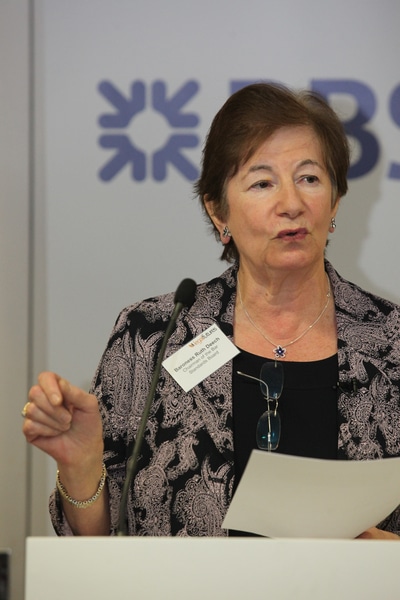
Deech: most advocates will sail through QASA
A last-minute Law Society bid to delay the controversial Quality Assurance Scheme for Advocates (QASA) until after the government’s consultation on price competitive tendering (PCT) for criminal work was yesterday rejected by the Solicitors Regulation Authority (SRA).
QASA moved a significant step towards implementation after final changes to its design were approved by both the SRA and the Bar Standards Board (BSB).
The BSB’s decision came with a plea from BSB chair Baroness Deech for lawyers to understand the necessity for QASA – and that most of them will “sail” through it.
The SRA’s board meeting heard Law Society representations urging the delay until after the Ministry of Justice’s plans for criminal legal aid were made clear. The society appeared to be responding to the arguments of criminal practitioners that QASA would be used by the government as a public demonstration of advocacy standards which would pave the way for PCT.
SRA chief executive Antony Townsend said the society believed “implementation of the scheme should be delayed… because [PCT] might have such a dramatic effect”. But he said the SRA board’s view was “that the two issues should not actually be associated in that way… and that the proposal should go forward”.
At the BSB meeting later in the day, Baroness Deech said: “If you stand back and look at the professions generally… in modern times – especially when public money is involved – it is expected that there would be some accreditation, some assessment of quality.”
Historically professionals have complained about such schemes and then the great majority “sail through them”, she said, adding that she expected this to be the case with criminal barristers. “If there are underperformers, it must be in the public interest for them to be identified and supported.”
She said QASA would help vulnerable clients unable to exercise a meaningful choice of advocate by ensuring they are “at least competent”.
BSB lay member Malcolm Cohen said he could not support QASA “on a matter of principle” because he did not consider there to be sufficient evidence to support the need for it in the Crown Court and above; he also reiterated his long-held concerns about how advocacy in youth courts is not properly addressed by QASA.
Papers before both meetings revealed the initial QASA accreditation fees that criminal advocates will be charged as being between £25 and £100 for registration, depending on the level of advocacy, with a flat fee of £125 across the board for progression within the scheme, and reaccreditation fees of between £75 and £125.
Assuming the final changes receive Legal Services Board approval, the first phase of the scheme is due to launch on 30 September 2013 on the Midlands and South-West circuits, followed by London and South-East in March 2014 and the remaining circuits in June 2014. The BSB is to propose that phase one should close two months later than the planned 10 January 2014.
The main final changes are:
- The period of time that advocates will have to acquire two pieces of judicial evaluation in order to enter the scheme is extended from 12 to 24 months;
- The number of judicial evaluations required for progression and reaccreditation has been reduced to bring it into line with the requirements for entry into the scheme;
- The ability for clients to consent to an advocate ‘acting up’ has been removed;
- Proceeds of Crime Act 2002 cases have been removed from the scope of the scheme; and
- Silks should be able to register as a ‘Level 4QC’.