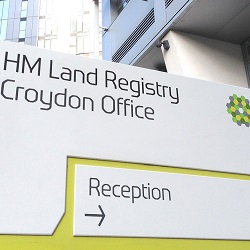
Land Registry: More legalistic culture
HM Land Registry (HMLR) needs to shift from a “quasi-legal” culture to one that is more consumer friendly given the changing nature of the home-buying process, according to a review.
Staff could also take a “dogmatic approach” to complaints, according to a report by City law firm Eversheds Sutherland that contributed to the findings of HMLR’s customer care review committee (CCRC).
“Until relatively recently, the conveyancer was the principal customer of HMLR… Over the years, this had the effect of embedding a more legalistic than customer service oriented culture within HMLR,” the CCRC said.
“The process of buying and selling property has undergone significant changes over the past 20 years, shifting from professionally trained conveyancers to more standardised, high-volume based processes.
“While this works effectively for straightforward transactions, more complex issues are often escalated to HMLR for resolution. Additionally, customers are now more likely than ever to engage directly with HMLR.
“As a result, HMLR needs to adjust its approach and focus on offering a business-to-customer (B2C) service as well as a traditional business-to-business (B2B) service.”
The CCRC recommended a “cultural programme” to support this.
Eversheds was asked to study 13 historic HMLR complaints files, seven of them relating to boundary disputes. Nine cases had been running for more than three years, with two going on for 10 to 20 years, and a further two for even longer.
Although the law firm found no “fundamental issues that cause us significant concern”, there were examples of “considerable delays” in responding to complaints and “potential conflict of interest” when staff involved in “the initial reason for the complaint” became involved in investigating it.
In three of the 13 cases, Eversheds said legal decisions by HMLR were incorrect and a further three partially correct, but they were “minor discrepancies that were capable of simple rectification”.
Eversheds said caseworkers should “remain objective and attempt to place emotions to one side”.
They “must deal with complaints professionally and even if they feel the customer is being rude and unfair, they should not mirror those behaviours.”
There was evidence across all 13 files of customers being “confused” by HMLR correspondence and “the sometimes overly technical responses provided”.
When responding to complaints, HMLR often took “a dogmatic approach – to adopt a position and stick to it, without question, seemingly being unprepared to consider alternative outcomes or compromises”.
In the 2023/24 financial year, HMLR received just over 9,100 complaints and HMLR also commissioned Deloitte to carry out an evidence-based analytical review of its complaints data.
This found that the categorisation of complaints was “sub-optimal”, complaint-handling procedures were “not well documented” and training was “inconsistently delivered”.
In its review of governance, the CCRC said there was “no single channel for complaints and identified 52 contact entry points for customers making a complaint into HMLR”.
Standard letters and templates used in correspondence “were found to be overly legalistic in tone and often not written in plain English”, despite the HMLR holding the Crystal Mark Plain English accreditation.
Customers who complained were not asked at the outset what the root cause of their complaint was or what resolution they were seeking.
The CCRC said that although there was “no evidence of systemic issues” with complaints handling at HMLR, “improvements can and must be made in how HMLR discharges this role in order to deliver higher levels of customer service”.
It made a total of 64 recommendations, with others including more use of mediation in boundary disputes.
Another was that HMLR work closely with conveyancers to reduce the number of requisitions, but work is already underway on that.