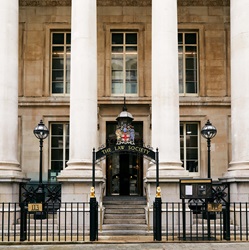
Law Society: Cap harmful to the profession
Solicitors yesterday voted to end the cap on the Law Society president’s pay at the salary of a district judge, given that the chair of the Bar Council’s pay is pegged to that of a High Court judge.
Former president Richard Atkinson told the annual general meeting that the difference was often mentioned to him when he held the post and he described it as “somewhat harmful” to the reputation of both the Law Society and profession as a result.
There was opposition to the move, given the struggles of some high street solicitors, but the motion laid by the society’s ruling council passed by 49 votes to 35.
The president’s compensation was capped at the annual salary of a district judge, which is currently £144,350. The vice-president’s compensation is 50% of this and the deputy vice-president’s 25%. A High Court judge is paid £234,096.
The motion did not specify a new cap but instead said the change “would permit democratically elected council members to have flexibility for making future adjustments to the levels of compensation payable to office holders that appropriately reflect the scope and purpose of their roles and duties”.
Former president Linda Lee argued that there was “no justification” for the change, which removed an “independent and transparent benchmark”.
She criticised the council’s failure to give proper reasons for it, stating: “No one takes the job for the salary.”
In drawing a comparison with the Bar Council, Mr Atkinson noted that the Law Society had more than 10 times the number of members.
A “reference point can be useful” and the council could well decide to set one, he said, but “it was repeated to me a number of times by members of the senior judiciary that they thought it rather strange” that the president’s pay was linked to that of only a district judge.
Jade Gani, co-founder of the SME & Boutique Law Firm Alliance, said she was opposed to “an uncapped potential increase”, while Alisha Butler, a director at Phoenix Legal in Birkenhead, said: “I would like the society to understand that, as a small law firm owner, for you to sit here and tell me you deserve more is quite hard.”
Another speaker from the floor warned that, with “trust in the society at an all-time low”, it was a bad move to “introduce something that says we want to reward our own with an uncapped salary”.
But outgoing council member Steven Mather argued that having a cap “restrains council from properly rewarding presidents”.
He went on: “It is not a role I would want to take. The amount of work a president has to do is incredible and the face of this society worldwide is down to one person… It is a role that is all-consuming to the detriment of quite a lot of other things in someone’s life.”
Council member Andrew Bishop told attendees that they could “trust council members on this”. They were practitioners too, who were elected by the profession to represent them.
The AGM also approved flexibility in determining when the presidency changes hands. The intention is that, while AGMs will remain in October, the presidency will be moved to run for the calendar year.