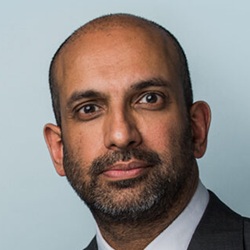
Menon: Hearing in four weeks’ time
The KC accused of not following court directions in his closing speech on behalf of a Palestine Action activist is to face contempt proceedings, a High Court judge has decided.
Mr Justice Nicklin has issued a summons for Rajiv Menon KC to appear before Mrs Justice Cheema-Grubb on 28 July for a two-day hearing.
He said he was “satisfied that there is evidence which raises a prima facie case that the respondent may have acted in contempt of court and that it is in the public interest for contempt proceedings to be instituted by the court”.
In January 2026, Mr Justice Johnson held that Mr Menon’s closing speech disobeyed his directions not to mention certain things, while expressly making no finding about whether that conduct was deliberate.
He referred Mr Menon [1] to the High Court for possible contempt but the Court of Appeal set the order aside after finding the High Court did not have jurisdiction [2].
However, the appeal court remitted the matter back to Johnson J to consider what other action he might take and last month the judge decided [3] that there was a case to answer in contempt.
He did not institute contempt proceedings himself but instead referred the case to a presiding judge in order to determine whether contempt proceedings should be pursued.
Nicklin J, the presiding judge of Wales, decided yesterday that they should be. “I am satisfied that there is sufficient material to justify the institution of contempt proceedings against Mr Menon KC in respect of parts of his closing address to the jury,” he said.
“That material is capable of supporting allegations that, in identified respects, the address departed from rulings made by the trial judge, or was in disobedience of them, in a manner arguably capable of interfering with, or creating a real risk of impeding, the due administration of justice.”
Nicklin J said he bore “fully in mind the importance of fearless advocacy” and the need for the court to exercise “real caution” before invoking the contempt jurisdiction in relation to what was said by counsel in the course of a criminal trial.
“At the same time, it is fundamental to the rule of law that orders and rulings made by a judge in the course of a criminal trial are obeyed by those participating in the proceedings, including the advocates appearing in the case.
“If a ruling is said to be wrong in law, or otherwise open to challenge, the law provides means by which that may be corrected. It is not for those participating in the proceedings to decide with which rulings they will comply and which they will not.”
Nicklin J listed multiple aspects of Mr Menon’s speech that could amount to contempt, including that, contrary to rulings and directions, he informed the jury of the principle of jury equity and asked them to apply it, told the jury that the judge may not direct them to convict, and invited the jury to disregard the court’s directions that they should put views of the Middle East and the war in Gaza, and emotion, to one side.
Further, he was accused of suggesting that the prosecution accepted, or did not dispute, evidence as to the history of the Middle East and the role of Elbit Systems in supplying weapons to Israel, and that this evidence was critical to the jury reaching true verdicts.
Mr Menon was also said to have “misstated or mischaracterised the court’s ruling and its answer to the jury question by suggesting that the court had prevented the defendants from pursuing a defence of lawful excuse, and that the court had ruled that the defendants had no lawful excuse for damaging property belonging to Elbit Systems…
“It is further alleged that, in the same speech to the jury, the respondent made statements which were capable of suggesting to the jury that the court was not impartial, in that he referred to the defendants being prevented from giving evidence about Elbit Systems, and later referred to Elbit Systems being ‘protected’ and ‘wined and dined in the corridors of power’.”