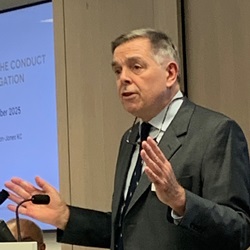
Treverton-Jones: Hard-edged guidance needed
Legal regulators should assure non-authorised people who may have inadvertently conducted litigation as found by Mazur that they will not face criminal prosecution or disciplinary action, a top KC has argued.
Greg Treverton-Jones KC also called on the Solicitors Regulation Authority (SRA) and CILEx Regulation to provide practitioners with “hard-edged guidance on what is and is not within the meaning of the conduct of litigation”.
The silk is a leading authority on legal regulation, and general editor of The Solicitor’s Handbook, published by the Law Society.
Speaking last night at a seminar organised by his chambers, 39 Essex, Mr Treverton-Jones said Mazur had caused “bigger ripples” than any other case he had ever seen. But with no indication that an appeal has been lodged, “that is now the law”.
He identified the 2023 decision of Mr Justice Cavanagh in Baxter v Doble as key, agreeing with the judge that it was difficult to identify a “clear dividing line” as to what constituted conducting litigation.
However, he questioned the judge’s comment that the court should look at the entirety of the activities undertaken “in the round”, given that the conduct of litigation without authorisation was a criminal offence under the Legal Services Act 2007.
“Surely in the criminal law, people are entitled to know what they can and what they can’t do. And surely equally, if you are doing one thing which amounts to the conduct of litigation, let us say issuing a claim form, isn’t that a crime? Isn’t that a breach of the statute? And isn’t that therefore a criminal offence?
“Why do you need to look at it in the round? My view, for what it’s worth, is that there is no escape from looking at each of the activities that are involved in the running of a piece of litigation and working out whether that is or is not part of the conduct of litigation.”
Other problems thrown up included the provisions in the Civil Procedure Rules that allow a non-authorised person to sign a statement of truth.
“If that isn’t part of the conduct of litigation, what is?” the barrister asked. “And if it is part of the litigation, what is the [Civil Procedure Rule Committee] doing… because it’s basically saying you can commit a criminal offence.”
Both Cavanagh J and the then Mr Justice Coulson in the 2018 case of Ndole said drafting a witness statement was part of the conduct of litigation, he went on. But in their interventions in Mazur, both the Law Society and SRA said proofing witnesses was not.
Mr Treverton-Jones said: “At what point does that document become part of the conduct of litigation? Why should the drafting of the witness statement involve the conduct of litigation?
“It’s surely only when it’s completed and being signed that an authorised person has to take responsibility for it.”
He put forward four solutions to the problems raised by Mazur. Given reports that chartered legal executives had been wrongly advised in the past about the need for practice rights, “it seems to me that experienced legal executives should be rapidly passported to being permitted to conduct litigation”.
He added: “I don’t think that the regulators can sit on their hands and say, well, it’s not our job to do this, and we are going to decouple the rights of audience from the right to conduct litigation [CILEx Regulation has applied to the Legal Services Board to do this].
“I think it all needs to be dealt with much more quickly than that and much more decisively.”
Secondly, the SRA and CILEx Regulation needed to “sit down together and come up with hard-edged guidance about what is and is not within the meaning of the conduct of litigation”.
There were, he said, “all sorts of grey areas” – was a part 36 offer, a Calderbank offer or a letter to the court dealing with the listing of a case part of the conduct of litigation?
“What about the use of template statements of case? We all know that there’s a huge spectrum in litigation. There’s some really humdrum stuff at one end of the spectrum – rear-end shunts, debt recovery work, some possession claims – that, let’s face it, does not need the skills of a solicitor or an authorised person.”
The Bar Standards Board has provided “that sort of hard-edged guidance to barristers”, telling them what they could and could not do. “If the BSB can do it, why can’t the SRA and [CILEx Regulation] together do it as well?”
Mr Treverton-Jones said that while, for most cases, regulators were not meant to give “safe harbour advice or guidance”, this was different.
“This is an area in which the regulators have got it wrong. The [rule committee] seems to have got it wrong. The judges don’t know what’s meant by the conduct litigation. Surely the regulators can step in, particularly as the SRA is the prosecuting authority for any crimes which are committed.”
His third recommendation was that the regulators should give a “published assurance” to non-authorised persons that inadvertent breaches before Mazur need not be reported and would not be prosecuted either under the criminal law or as a disciplinary matter.
This effectively happened earlier this week with CILEx Regulation, which said its “current position is that CILEX members practising in line with the prevailing guidance and their firms procedures in operation at the time pre-Mazur are not required to self-report to CRL”.
It continued: “If a complaint is made to [us] we will always consider the specific facts of a case, taking into account the factors relevant to the environment in which the professional is working. This includes taking into account any relevant information about guidance and procedures in place at the time.”
Finally, the KC doubted any of this was anticipated by the drafters of the 2007 Act. So there should be a statutory amendment to permit delegation to non-authorised persons under supervision in the same way that existed for other reserved legal activities. This would make the whole problem “disappear”.
In her address, Katherine Apps KC said the Ndole case was clear that the effect of a breach was not to render the underlying litigation a nullity.
An argument of abuse of process did not work in Mazur but it could be if a party was “materially misled”, she went on, while she would not be drawn on the impact on costs, saying it was already before the Senior Costs Judge.
Ms Apps did warn that the Hamid jurisdiction – the court’s inherent power to enforce duties that lawyers owe to it – had been exercised against non-authorised persons conducting litigation in the past.
This included a case last year where a paralegal and their supervising solicitor were referred to the SRA after the former falsely represented that she was a solicitor authorised to conduct litigation on two different court forms by putting her name in the box headed ‘Solicitor’s name’.
The CILEx Regulation update this week also said it was recruiting additional staff to handle the increased demand for practice rights authorisation and has had “productive discussions with ULaw on their parallel route to obtain rights, and they are setting up extra provision”.