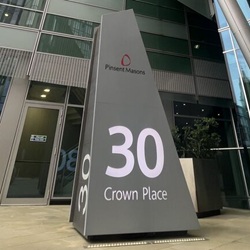
Pinsent Masons: Self-reported to SRA
A junior solicitor who used artificial intelligence (AI) to draft two misleading emails to the High Court “seems to have almost entirely outsourced the thinking process to the program”, the judge has said.
Insolvency and Companies Court Judge Mullen decided [1] that leading law firm Pinsent Masons’ self-referral to the Solicitors Regulation Authority (SRA), alongside the public admonishment of a published ruling, was a sufficient sanction.
Pinsent Masons sought to protect the junior, referred to solely as ‘LA’, or Lawyer A, and the judge decided he did not want to spend more court time deciding whether they should be publicly named.
Instead, their supervisor, senior associate Samantha Poulton, and her supervising partner Steven Cottee provided evidence to the court. This highlighted a failure of supervision.
The underlying matter was uncontentious ‘boxwork’ for the judge: a block transfer application to replace the respondent in his role of administrator or liquidator to various companies because he was moving to a new firm.
This kind of uncontested application left the court particularly vulnerable because “there is no opposing party to point out an error in correspondence sent to the court”, Judge Mullen noted.
The draft order also provided for the respondent to be released from liability without the need to apply to the Secretary of State.
Judge Mullen explained that, while he had the power to do this in relation to administrators, it was less clear with liquidators. He asked Pinsent Masons to identify where this power existed.
The firm’s reply on 30 March included the reference to a specific power and appeared to quote the relevant provision in the Insolvency Rules 2016 (dubbed the ‘purported text’), which the judge said “came as a surprise to me”.
“I was taken aback to be told there was such a clear rule in the IR 2016 setting out the court’s power in this regard, of which I was previously unaware, despite having cause to look at that chapter of the IR 2016 periodically.
“I therefore checked IR 12.37(5) on the legislation.gov.uk website and in a practitioner text to find that it says nothing of the sort.”
He asked Pinsent Masons to explain the letter. The response on 14 April “again proposed the alternative course set out in the 30th March letter… I was astonished by this reply. The explanation was impossible to accept”.
The judge ordered a hearing and witness statements. Ms Poulton told the court that she was aware LA used AI “from time to time, but she was unaware that AI was being used by LA in relation to this application”.
She accepted that there was a failure on her part to supervise LA and check the drafts properly and that she should have escalated the matter before the 14 April letter was sent.
Mr Cottee’s “limited involvement” came in approving the 30 March letter.
Julie Herriott, Pinsent Masons’ compliance officer for legal practice, told the court that given LA’s junior status and the firm’s duties to its employee, and in view of the other two solicitors’ involvement, LA had not been identified by name.
The judge also heard from partner Claire Francis, chair of Pinsent Masons’ innovation and change board, who outlined further steps taken to put further safeguards on AI’s use.
“I have been left in no doubt that Pinsent Masons is taking this matter very seriously and is seeking to address the risks identified,” Judge Mullen said. This included self-reporting to the SRA.
The firm did not name LA in the report but subsequently they identified themselves to the regulator.
The transcript of LA’s conversation with the AI in creating the letters was provided to the court. “What is remarkable when reading those chats is, first, that one would think that the text attributed to the AI was produced by an intelligent human being,” Judge Mullen recorded.
“The second remarkable thing is that, on a large number of occasions, it is plainly wrong or, at the very least, extremely misleading.”
LA used the AI to draft the 30 March letter and the hallucinations “began almost immediately”. Later on, the AI warned about the need to check the provisions to which it referred. “Assuming that LA did not check the text of the rule, I consider this omission inexcusable.”
Both Ms Poulton and Mr Cottee admitted not checking the purported text before the 30 March letter was sent.
Ms Poulton also admitted not reviewing the 14 April letter “with the necessary care required”, saying she was “mortified” that inaccurate statements of the law were sent out in the firm’s name.
Judge Mullen said: “LA seems to have almost exclusively relied upon AI to provide the answers and did not check its references, even when told to do so by the AI itself.
“LA does not seem to have alerted their supervisors to this fact, or apparently tell them that AI had been used.”
The 14 April letter was not primarily the result of an AI hallucination, although it included hallucinated elements. “It was a construction, after the event, of a rationale for stating that the purported text was a mere summary of a number of provisions of the IR 2016 and should not be understood as a quotation.
“That was an unjustifiable response and an opportunity to set the record straight became a further instance of misleading information being put before the court.”
Judge Mullen said “there appears to have been a failure to supervise LA adequately” in respect of the 30 March letter, while for the 14 April letter, “Ms Poulton should have more thoroughly investigated the reasons for an egregious misstatement having been placed before the court”.
He concluded that “this is plainly a case where admonishment is insufficient” but decided that referral for contempt of court proceedings was “disproportionate”. The referral to the SRA was “appropriate”.
He commented that LA’s conduct was “very troubling”, especially given their failure to check the purported text after the AI urging them to do so.
“Having considered the AI transcript chats it seems to me that the production of the letters may well have resulted from a serious lack of care and of judgment on the part of LA rather than a want of honesty.
“There is nothing to suggest that LA checked any of the references generated by the AI and LA seems to have almost entirely outsourced the thinking process to the program.”
Pinsent Masons covered any extra costs for its former clients caused by these events; Irwin Mitchell took over acting for them.