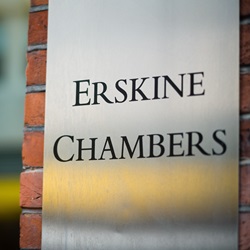
Erskine Chambers: Reported applicant to SRA
A junior solicitor at a leading City law firm who lied about his academic achievements on a pupillage application when trying to move to the Bar has been struck off.
The Solicitors Disciplinary Tribunal (SDT) accepted that Maxmillian Alexander Knowles Campbell was suffering from a depressive illness at the time but this was not enough to displace the presumption that dishonesty leads to a strike-off.
Mr Campbell, who is 34, qualified in March 2020 and was working as an associate at Slaughter and May in early 2022 when he applied to Erskine Chambers for pupillage.
His application stated that he had achieved a double starred first-class degree at Cambridge University and been awarded the ‘Slaughter and May Prize’ for best overall performance. In truth, however, he got a 2:1 and did not receive the prize.
According to the Solicitors Regulation Authority (SRA), following a second interview at the chambers, the panel felt that Mr Campbell’s performance had been “far below the level that one would have expected of someone with his academic credentials”.
The panel reviewed his application and noted that there had been no response to its email to Mr Campbell’s academic referee at Cambridge, Dr Markus Gehring.
Erskine discovered that the email address provided was incorrect and so contacted him using the address listed on the university’s website. Dr Gehring’s response confirmed that Mr Campbell received a 2:1.
Later the same day, Dr Gehring emailed again to say: “So, sorry – there must have been a case of mistaken identity. Please ignore my reference – Max seems unaware this application.”
He forwarded an email from Mr Campbell which said he “had been the victim of a practical joke and had not applied for pupillage”.
Erskine Chambers reported him to the SRA and Mr Campbell self-reported the following week.
The set also told Slaughter and May. He resigned ahead of its investigation, telling the firm that he had intended to apply to the Bar in 2023 and decided to apply to a couple of chambers in 2022 as exploratory applications and to gain interview practice.
Before the SDT, Mr Campbell admitted what he had done but argued that his case fell within the residual category of dishonesty cases where exceptional circumstances meant he should not be struck off.
He supplied a psychiatrist’s report that concluded he was suffering from a major depressive disorder at the time of the misconduct.
The doctor’s opinion was that this “significantly impaired” Mr Campbell’s ability to think clearly and rationally, and his ability to objectively appreciate the morality of his behaviour.
His counsel further submitted that Mr Campbell had not sought financial gain or a genuine pupillage placement, but rather interview experience “as part of a misguided attempt to escape his deteriorating personal and professional situation”.
The conduct was described as “irrational and self-defeating, and not the product of calculated deceit”.
But the SDT decided that Mr Campbell’s conduct was “designed to gain advantage through the selection process. It was not a momentary lapse or a reaction to immediate pressure, but a sustained course of conduct”.
He had “multiple opportunities” to correct the dishonesty but chose not to do so.
“While the tribunal acknowledged [Mr Campbell’s] mental health condition and accepted that he was suffering from a depressive illness at the relevant time, it did not find that this impairment was sufficient to reduce his culpability to the extent required to establish exceptional circumstances.
“The tribunal concluded that the dishonesty was not isolated, and the surrounding circumstances, though unusual, did not justify a departure from the presumptive sanction.”
Mr Campbell has not worked as a solicitor since leaving Slaughter and May in April 2022. He now works in New York.
The SDT struck him off and ordered him to pay costs of £6,110.