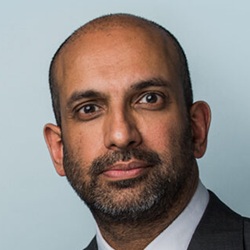
Menon: Had two weeks to prepare closing speech
The KC accused of not following court directions in his closing speech on behalf of a Palestine Action activist has been referred to a presiding judge to consider contempt proceedings.
Mr Justice Johnson said referring Rajiv Menon KC to the Bar Standards Board instead would not “adequately meet the public interest”.
In January 2026, Johnson J held that Mr Menon’s closing speech disobeyed his directions not to mention certain things, while expressly making no finding about whether that conduct was deliberate.
He referred Mr Menon to the High Court for possible contempt but the Court of Appeal set the order aside after finding the High Court did not have jurisdiction.
However, the appeal court remitted the matter back to Johnson J to consider what other action he might take.
In his ruling yesterday, the judge decided that there was a case to answer in contempt.
Given Mr Menon’s experience and eminence – until last year, he was head of Garden Court Chambers – there had to be cogent evidence of a contempt, he acknowledged.
“I start from the position that it is highly unlikely that Mr Menon would deliberately disobey an instruction from the court or otherwise act in contempt of court or otherwise mislead the court.”
But his speech contained “serious and repeated non-compliance with the court’s rulings throughout the case as to what was admissible, how the jury should be directed, and what counsel should not say to the jury”.
Johnson J said he did not need to decide at this stage whether Mr Menon intended to act as he did – that would be for any judge hearing the contempt proceedings.
But he added: “Subject to any explanation, it is a natural inference from his knowledge of the rulings, his experience as an advocate, and the content of his speech, that he deliberately breached the rulings.
“It is not easy to see how he could have believed that his speech was consistent with the court’s rulings.”
He went on to decide that it was in the public interest to pursue proceedings, even though he recognised that Mr Menon was in the “difficult ethical position” of acting for a defendant who had admitted all the ingredients of the offence of criminal damage, and did not have a defence, yet pleaded not guilty.
“He had an overarching duty to the court to comply with the court’s rulings and with his professional obligations. But he also had a subsidiary duty to his client to represent her to the best of his ability, so far as was consistent with his duty to the court and his professional obligations.
“In this context, there are public policy reasons to allow Mr Menon the maximum permissible latitude in the manner in which he chose to discharge his professional responsibilities.”
A sanction would also interfere interference with rights of free speech and the right to a fair trial.
But the court had given “direct and clear instructions as to what counsel could not say to the jury” and Mr Menon had two weeks to prepare his closing speech.
“His speech was apparently scripted. There is a case to answer in contempt not just on the basis of an isolated remark in the speech, but in respect of much of the content, structure and effect of the speech.
“That being the case, and subject to the consideration of alternatives, there is a strong public interest in considering the initiation of contempt proceedings.”
The judge said he also took into account the “very considerable” consequences Mr Menon had suffered as a result of the allegations, as well as the argument that any further steps would have a chilling effect on defence advocacy.
But it would nonetheless “not be in the public interest to take no further step. That would not adequately discharge the court’s responsibility to ensure that its rulings are treated as binding and, where necessary, enforced”.
Referral to the Bar Standards Board would not adequately meet the public interest because of the delay it would cause and because it would “effectively delegate the court’s responsibility for enforcing its own orders to an external regulator”.
Further, he decided against referring the case to the law officers as it was “not the type of case where [they] have generally instituted contempt proceedings”.
Johnson J went on to hold that the court has power to institute summary contempt proceedings of its own motion and decided it would be more appropriate for another judge to be assigned to the case.
“I stress that nothing in this judgment decides that Mr Menon has acted in contempt of court. That can only be decided if contempt proceedings have been instituted and then only if a judge finds that a contempt has been established to the criminal standard of proof.
“Nor have I decided to institute contempt proceedings. I have, instead, decided that the papers should be referred to a presiding judge in order to determine whether contempt proceedings should be instituted.”
In a statement, Garden Court Chambers said it “stands in full support” of Mr Menon. “The unprecedented contempt of court proceedings brought against Rajiv… undermine and diminish our system of criminal justice.
“The administration of justice depends upon an independent Bar willing and able to act in the best interests of their clients, fearlessly and with integrity.
This attempt to criminalise a member of the Bar over the contents of a closing speech made in defence of their client has sent shock waves through the legal profession.”