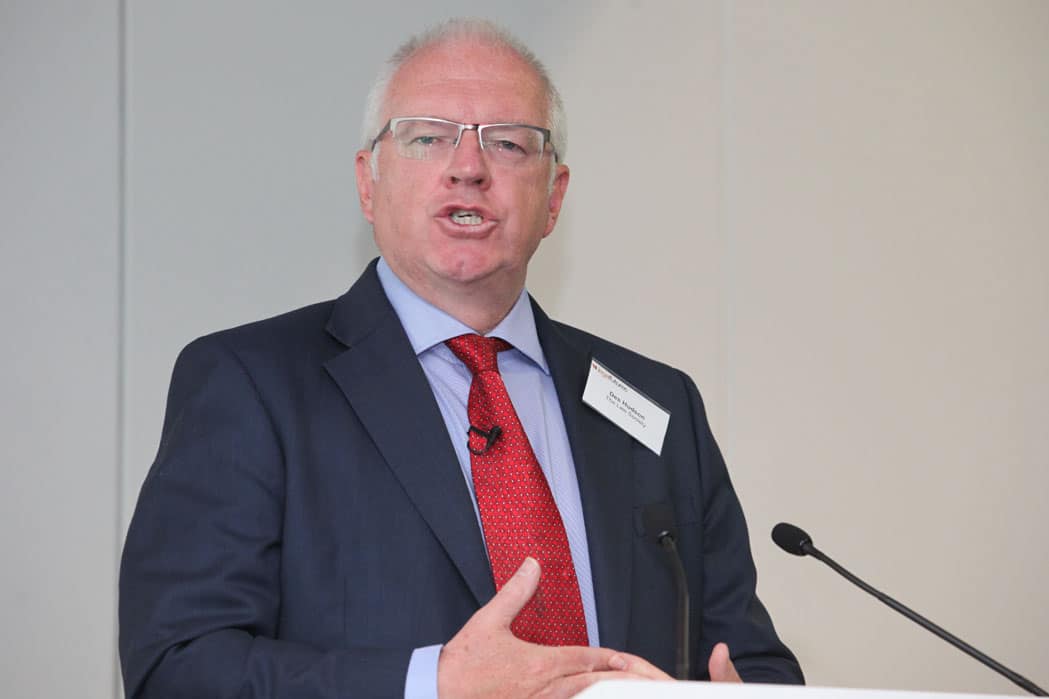
Hudson: there would be ‘super-panels overnight’
Solicitors Regulation Authority (SRA) plans to prevent mortgage lenders from claiming on solicitors’ compulsory indemnity insurance will “destroy high street conveyancing”, Law Society chief executive Des Hudson has claimed.
Mr Hudson said lenders would simply respond by “introducing super-panels overnight” and, if he were a conveyancer, he would “buy a ticket to Rio” – in other words, give up.
Radical changes to indemnity insurance arrangements and the solicitors’ compensation fund are a central part of the SRA’s reform programme, launched earlier this month.
One of the changes would remove the right of businesses with annual turnovers of more than £2m a year to rely on compulsory indemnity insurance.
Speaking at last week’s Manchester Law Society regulatory conference, Mr Hudson said he was “very, very nervous” about the SRA’s timetable for introducing the change, and questioned whether the market would be ready by August.
“If you think we have a problem with conveyancing panels now, wait until August,” he said. “At the very least, I would need time to put together an insurance product to help these firms.”
Mr Hudson said other parts of the SRA’s reform programme, including plans expected later in the year to relax the conflict of interest rules, raised “difficult philosophical questions”.
He went on: “I’m not sure whether they see us as a business made up of former professionals with some professional standards, or a profession.
“Are we people who just happen to be lawyers, but are really just running a business? What is it that society wants of its lawyers?”
Mr Hudson questioned whether conflict of interest rules for large clients should be relaxed, and whether the relationship between solicitors and clients should depend only on contracts, and terms and conditions.
He said the SRA’s proposed move towards self-certification for continuing professional development (CPD) was “logically consistent”, but there was a need for solicitors to “demonstrate certainty” to clients that training had been carried out.
Mr Hudson compared the relationship between the Law Society and the SRA to that between “the government and Her Majesty’s opposition”.
He said: “There are times when we need to disagree, but things are improving. What we need to change is what happens when the machine doesn’t work, so there is more collaboration with the Law Society.”
The Law Society chief executive said he did not expect to see a “rapid growth” in the number of alternative business structures (ABSs), but warned of the “enormous success” of insurers in using them to provide personal injury litigation.
“Estate agents own the first client relationship point. Exactly the same thing is happening with insurers”.
The most important thing about ABSs was not the structure, Mr Hudson said, but whether there was “innovative action”, such as the pricing models introduced by Riverview Law or Irwin Mitchell.
Mr Hudson said the combination of the recession, regulatory uncertainty since the Legal Services Act, and “intensive and unremitting” pressure on pricing had made it a “really difficult time” for solicitors in private practice.
He said that only the top 5% of firms had increased profits in the past 12 months, and this was driven largely by cost control, rather than pricing power or growth in the market.
He predicted that the future of legal services would be “very attractive for the most able lawyers”, but the highest rewards would go to a “very thin crust”.
Quality legal services would be increasingly accessible only to affluent private clients or the very poor, excluding most basic rate taxpayers, and with “a lot more DIY” at the bottom end.
“It will be harder as a lawyer going forward,” Mr Hudson said. “The practice of law will be demanding, increasingly polarised and increasingly focussed on high-end activities beyond black-letter law. It will be a complex, nuanced, interesting time.”