


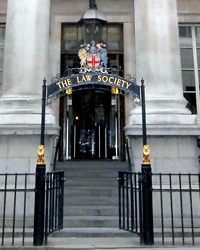
Law Society: too late to challenge adoption of FoI
Dr Alan Blacker – the solicitor who has found himself at the centre of constant attention since a judge in 2014 described him as dressing “like something out of Harry Potter” – has failed in his bid to challenge the Law Society’s freedom of information (FoI) code and stop it releasing information about him.
The High Court struck out his application to injunct the society – or, in effect, the Solicitors Regulation Authority – because it disclosed no reasonable grounds for bringing the claim.
The action followed an FoI request from a member of the public known only as YZ in relation to Dr Blacker’s activities and those of his firm, Alan Blacker & Co, and the related charity he runs, the Joint Armed Forces Legal Advocacy Service (JAFLAS).
YZ was not happy with the SRA’s response and challenged it before the society’s FoI adjudicator, Adam Sowerbutts. He upheld the challenge to a limited extent and directed that six files, referred to as the ‘Closed Files’, should be made available to YZ in redacted form. It also emerged that three further files existed in relation to Dr Blacker.
Dr Blacker, who goes by a variety of titles, most notably Lord Harley, wanted to restrain the release of the Closed Files and be provided with all nine files.
Mr Justice Fraser was critical of the SRA and Law Society in some respects – a redacted part of the adjudicator’s finding which was published on the society’s website could initially be decoded, while Dr Blacker was given just 48 hours to comment on the impending release of the documents.
However, the judge said that the information that was to be disclosed did not contain any personal information about Dr Blacker other than what was already in the public domain.
Fraser J continued: “Dr Blacker’s arguments, in summary, are that the information remaining still identifies him and that he would and does find that embarrassing, and if disclosure occurs it will unleash a torrent of adverse, embarrassing and misconceived comment, and cause mischief.
“However, his ultimate point is that the Law Society’s adoption of the code in 2005, and behaviour as though the [Freedom of Information] Act applies when it does not, is contrary to his rights in various respects. The first point may be right, but that does not grant him a cause of action in my judgment. In various public places, not least the website of JAFLAS, he is happy to be described as a solicitor and that is a regulated profession. One consequence of being a member of a regulated profession is being subject to that profession’s regulator.
“The adoption by the Law Society of the code in 2005 cannot be subject now to a claim for damages by a solicitor unhappy with its terms. If anything, it would be a matter of public law – but I hesitate to go further as this may be misconstrued as encouragement.”
Further, he found Dr Blacker’s reliance upon the Human Rights Act to be “misconceived”, while the files were created by the SRA and Dr Blacker had no proprietary right in them. “I fail to see how in those circumstances he can have any right to delivery up of the Closed Files.”
The judge concluded that even if he was wrong to strike out the claim, he would in any case have granted the SRA summary judgment.
In July, Dr Blacker is set to appear before the Solicitors Disciplinary Tribunal to face charges relating to accounts rule breaches, the accuracy of his claimed titles, qualifications and accreditations, recklessly misleading a Crown Court, and failing to co-operate with the SRA.
An SRA spokesman said: “We welcome the judgment, which agrees to strike out the claim as we requested. Mr Justice Fraser also recognised that the files requested by Dr Blacker belong to us and he has no claim to them.
“We are sorry that information was published without being properly redacted. We have already reviewed our processes for responding to freedom of information requests and we are keeping them under review. We will look at the detail of the judgement and see if any further changes need to be made.”