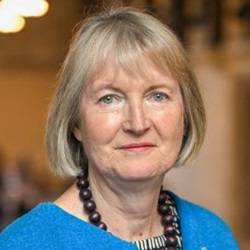
Harman: First solicitor Solicitor General
Solicitor Harriet Harman KC has been named as chair of the Bar Council’s independent review of bullying and harassment, including sexual harassment, at the Bar.
The Bar Council committed to having a review after research last year found bullying, harassment and discrimination a “systemic” problem, with 44% of barristers saying they have experienced or witnessed it in the previous two years – compared to 38% in 2021 and 31% in 2017.
Women from ethnic minorities were three times more likely than white men to have faced bullying or harassment – and six times more likely to have experienced discrimination.
Ms Harman, who is standing down at this election after 42 years in Parliament, will be supported by a review team – Samantha Granger, a barrister at the House of Commons, and Clare Gosbee, her parliamentary adviser – and a reference group. The review is due to report in June 2025.
Members of the reference group include Dame Laura Cox, a former High Court judge and member of the independent inquiry into the bullying and harassment of House of Commons staff; Michael Maguire, a disciplinary panel lay member at the Judicial Conduct Investigations Office; and representatives of the Bar, young Bar, Institute of Barristers’ Clerks and Legal Practice Managers Association.
The Bar Council invited expressions of interest for the role and said that a number of candidates were interviewed by a panel that included current chair Sam Townend KC and vice-chair Barbara Mills KC, as well as members of its equality, diversity and social mobility committee.
Ms Harman practised as a solicitor for eight years – first at Brent Law Centre in North London and then the organisation now known as Liberty – before being elected in 1982.
A former deputy leader of the Labour Party and cabinet minister, in 2001 she became the first solicitor to hold the post of Solicitor General, for which she took silk. In the last Parliament, she chaired both the joint human rights committee and the committee on standards and privileges.
Unveiling the report, then Bar Council chair Nick Vineall KC said the problems it identified were both cultural and “a consequence of the external pressures on professional life within an acutely under-resourced justice system. This is therefore a systemic issue for the Bar”.
Accepting the recommendation for a review, Mr Vineall said “the profession’s response cannot be to focus on reporting alone”.
He explained: “Waiting for individuals to make complaints places the burden of effecting collective cultural change on those most gravely affected. Our experience of this, and evidence from elsewhere, shows that this will never work and will not address the systemic issues which create the problem.
“The solutions are complicated. We believe encouraging and responding to individual reports must now be combined with more preventative measures.”
Earlier this year, Attorney General Victoria Prentis KC agreed that more than individual reports was needed to tackle the problem.
The review will seek to identify the reasons for the levels of bullying and harassment – along with the impact, the efficacy of current counter-measures, reporting mechanisms and support services – with the ultimate goal of identifying prevention and mitigating strategies that will help address unacceptable behaviours.
The review is being launched with a call for evidence for all interested parties.
Mr Townend said: “As a former Solicitor General and widely respected chair of cross-party inquiries into standards, Harriet Harman KC is the right person to take forward this review. Harriet understands the legal professions and justice system and her wider work in Parliament will bring fresh thinking to a very difficult problem.
“The Bar Council is committed to tackling the problem of bullying and harassment at the Bar and I encourage everyone to feed into the review to give us the best opportunity to change culture and find effective solutions.
“While the review completes its work, I repeat my call for those who observe inappropriate behaviours to not leave it to the victim to take action.
“All of us – opponents, bystanders – can do something, whether that is simply acknowledging it to the person who has suffered it to offer support or raising matters through heads of chambers, circuit leaders, resident judges, the inns, and the Bar Council’s own anonymous reporting tool, Talk to Spot.
“This will all contribute to helping change the culture that is needed.”
Ms Harman said it was to the Bar Council’s “credit” that it had acknowledged the problem and determined to take action.
“I look forward to hearing from the Bar, and all those connected with the profession, about the changes that are necessary to ensure that bullying, harassment and sexual harassment become a thing of the past.”
Ms Mills added: “The Bar is not alone in needing to tackle bullying and harassment, but there are Bar-specific reasons and impacts, and there will be Bar-specific solutions.”