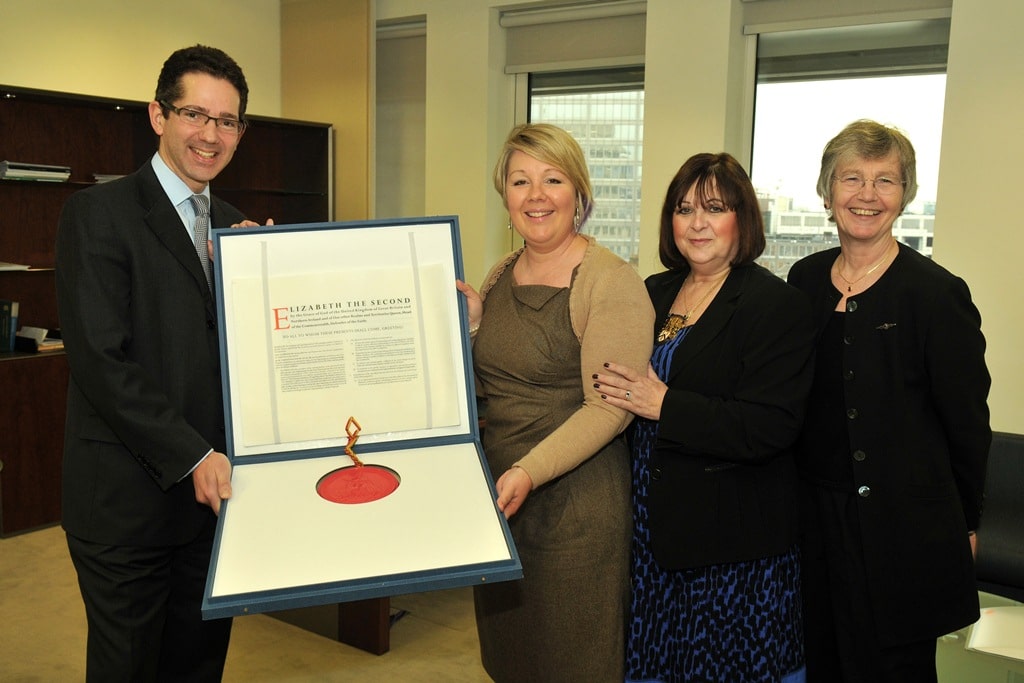
Justice minister Jonathan Djanogly presents the Royal Charter to (l-r) Helen Whiteman, CILEx head of corporate affairs, president Susan Silver and chief executive Diane Burleigh
The Institute of Legal Executives was formally presented with its Royal Charter yesterday, transforming Fellows of the Institute into Chartered Legal Executives.
The charter – handed over the justice minister Jonathan Djanogly – protects the title of ILEX members for the first time, distinguishing Chartered Legal Executives from non-qualified people who are described as ‘legal executives’.
It signifies formal public recognition for high standards in qualification, regulation and representation.
The charter only covers the new Chartered Institute of Legal Executives, which will use the acronym CILEx and has unveiled new branding. Both ILEX Professional Standards and ILEX Tutorial College will retain their existing names and branding.
CILEx president Susan Silver said: “This is a terrifically exciting time in the history of our Institute. The granting of our Royal Charter has taken years of hard work and determination by our head offi
ce teams, council members and especially our membership.
“It is our work out there in all communities which crosses the boundaries of all social backgrounds that has shone through. This is a time to trumpet our success and to be proud that every level of membership from students to Chartered Legal Executive lawyers serves the community with integrity and unmitigated professionalism.
“The charter reflects all of those values. We are so proud to be allied to the Chartered Institute of Legal Executives.”
Mr Djanogly said: “Legal executives make a valuable contribution to the legal industry and their commitment to providing the British public with legal services should be recognised. It is a great achievement and I am pleased to present president Susan Silver with its Royal Charter.”
Charters, granted by the Queen on the advice of the Privy Council, have a history dating back to the 13th century but are rarely granted nowadays. New charters are normally reserved for bodies that work in the public interest and which can demonstrate pre-eminence, stability and permanence in their particular field.
The Institute celebrates its fiftieth anniversary next year. Last autumn it cited by Deputy Prime Minister Nick Clegg as the prime example in the legal profession of social mobility in action. “If you are serious about social mobility, it seems to be that a huge part of the solution lies right on your doorstep – or at least back in your offices,” he said.