


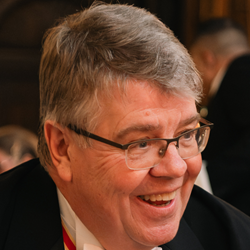
Coulson: Circuit judges are the heroes of the system
Being a judge is “the best job in the world”, according to Sir Peter Coulson, who has marked his retirement from the Court of Appeal by publishing a book today entitled The Practice of Judging.
In a wide-ranging interview with Legal Futures, he talked about rude barristers, the ailment of ‘judgitis’ and why there need to be more solicitors sitting in the higher courts.
Sir Peter, who was called in 1982 and took silk in 2001, was best known for his construction practice while at the Bar.
He was appointed to the Technology and Construction Court in 2004, becoming a High Court judge in 2008 and judge in charge of that court in 2016. He joined the Court of Appeal in 2018 and served as deputy head of civil justice from 2017 to 2021.
His highly readable book takes readers from appointment to sitting in the criminal and civil courts, how to deal with the challenges involved, and on to topics like ex tempore judgments, judgment writing, issues that arise out of court, and “things not to do”. He also reflects on some of the more notable cases he has handled.
While ‘don’t seek publicity’ and ‘don’t court the press’ are two of the things not to do, they are rules that can be relaxed as a retired judge with a book to promote.
Looking back at 25 years on the bench, he said that the biggest change over that period – aside from technology – was “the sheer amount of work that judges do”.
As an example, he cited applications for permission to appeal against either conviction or sentence, a batch of which all High Court judges were given every month. Whereas in the early days the judge would write simply that the application had no real prospect of success, now there need to be proper reasons
Sir Peter believed this was right, given it was the appellant’s last hope – the same in civil in the Court of Appeal with applications for permission to appeal – “and so those orders and the reasons for them can now run to two or three pages because the judge has sat down and really thought through how and why something doesn’t work”.
The funding crisis – identified in the final chapter of current pressures facing judges – made this worse. “The court service has been the Cinderella for a very long time, and I think it does show.”
Sir Peter is unhappy that the previously unspoken rule that a judgment be delivered within three months of the end of the hearing has effectively become a formal rule.
He only failed to do this once – after having two six-week trials back to back – but said “it really does put pressure on busy High Court judges who often do go from one trial to the next with little or no judgment writing time”.
Another pressure is the growing number of litigants in person. “Some of them are just that breed of people who are just difficult for the sake of it,” Sir Peter said. “Perhaps they feel wronged as a result of something that they say they’ve been cheated of years before, but their claim has been dismissed or whatever. And so their revenge on the court system effectively is to flood it with useless applications.”
But he stressed that many litigants in person do their best and said he was sympathetic with their use of AI – “very often it’s the only friend they have” – even if that led to hallucinated citations.
How about the Bar? “Generally speaking, I’ve been very lucky because I’ve done work at the posh end of the scale and generally counsel are excellent and professional to their fingertips. But I have noticed there can be an element of ego that creeps in to grander counsel…
“My wife [a circuit judge] would say that counsel can sometimes be abominably rude. Grand counsel appearing for privately paid clients in a Crown Court can often really not be professional at all.” They could sometimes believe their own hype, he suggested.
Then there are those who throw everything at the wall – and hard. “It’s the classic thing that if arguments are advanced overly aggressively, and particularly on appeal, if every point is taken, the judge immediately suspects that the whole thing is a lot of old rubbish.
“It’s much better where counsel says, ‘I simply have three points’, and makes them in clear and measured terms. And if the three points are right, then the appeal, say, would be successful. There are some barristers out there who take every point and are not doing themselves or the profession any favors.”
This was perhaps “a failure of self-belief – they’re so concerned that, if they concede anything, it might turn against them that they decide that they’re going to take everything and the kitchen sink”.
Judges, however, were “better behaved” than when he was in practice, “but so they should be. I think that if a judge behaves badly nowadays, it’s much more likely to not stay within the courtroom that afternoon, but to become sometimes even a cause célèbre”.
Cases of ‘judgitis’ – becoming obsessed with your own self-importance – were not as common as they used to be, he said.
“Funnily enough, it wasn’t the arrogant barrister who then becomes a judge in his mid-50s and thinks that the world’s his oyster. It was very often people who were apparently terribly nice at the Bar, and then they become judges and suddenly they just think that everything else has to kowtow to that.”
More broadly, he views “the real heroes and heroines of the system” as the circuit judges “who do ghastly criminal cases week in, week out, and they have to really be able to turn it off or they’d go under”.
All of his judgments, sentencing remarks and so on filled over 40 lever-arch files. One of the more eye-catching tips for judgment writing is the need for a “fuck it button” – the need to stop tinkering and just send it.
This linked to the issue of delay, because “there are some judges who just can’t bear to press the send button”.
Sir Peter acknowledged the need to improve diversity on the bench, especially for those from an ethnic minority, but also felt very strongly about having more solicitors.
“In the Court of Appeal at the moment, two of the best judges, Lady Justice Falk and Lady Justice Whipple, were both solicitors.
“The problem, at least in part, comes from the fact that [solicitors’] firms are not at all encouraging, and in fact positively discouraging, because if partner X is off sitting as a deputy high court judge, they’re not earning money for the firm… I would’ve thought the prestigious nature of it would make people not be quite so shortsighted.
“We definitely need more solicitors because it’s nonsense to say that somehow barristers make good judges and solicitors don’t. It depends on the individual, and just because a barrister may have been in court more is no possible reason for differentiation. So we definitely need more solicitors, but for that, we need the assistance of the solicitors’ firms.”
Since retiring, he has joined 4 New Square as an arbitrator and adjudicator – he is the author of Coulson on Construction Adjudication – and been appointed to the Premier League appeal board as well as the Astana International Financial Centre Court, whose chief justice is the former Lord Chief Justice of England and Wales, Lord Burnett.
He concluded by saying he would recommend being a judge “to anybody in a heartbeat”.
“It is the best job in the world. I absolutely loved it. For me, there was no downside at all. I mean, obviously, you have that odd thing where you take a bit of a financial hit, but enjoying something every day is beyond price, and that’s how I found my long stint as a full-time judge.”












Leave a Comment