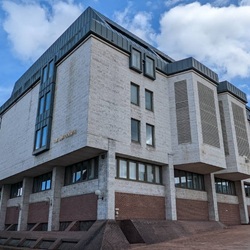
Maidstone County Court: Client could smell alcohol on barrister’s breath
A barrister who collapsed at a court while drunk and was taken to hospital in an ambulance has been fined £1,000 by the Bar Standards Board (BSB).
Following the incident, James Frederick Hankinson “voluntarily stepped away from practice at great personal cost, effectively taking a five-month self-imposed suspension”.
Mr Hankinson “also voluntarily continued to supply toxicology test reports to chambers at his own expense, to demonstrate his ongoing abstinence from alcohol”.
The case was handled via the BSB’s ‘determination by consent’ procedure, an alternative to a disciplinary tribunal for cases where there is no substantial dispute on the facts and the misconduct would not warrant disbarment or suspension.
An independent decision-making panel makes a decision and the barrister chooses whether or not to accept the outcome.
The panel recorded that Mr Hankinson attended Maidstone Combined Court in March 2025 “under the influence of alcohol to the extent that he was drunk at the court and collapsed”.
The barrister “was incapable of representing his client” at the hearing which was scheduled to take place that day and the matter was adjourned.
Mr Hankinson told his chambers what had happened, as did his client, who reported that “they had noticed a strong smell of alcohol from Mr Hankinson, he had exhibited red eyes, and he had slurred speech when they met him at the court earlier in the day”.
The client obtained “alternative, more senior legal representation through chambers”, and the hearing was relisted for four weeks later. Mr Hankinson personally compensated the client for their loss of earnings.
The barrister, called in 2014, admitted breaching the BSB code of conduct. He “stated his deep regret for what had happened and said that he was incredibly ashamed of his actions”.
By way of mitigation, he submitted that the incident was “an isolated, one-off occurrence”.
His chambers had “provided a support network and assisted Mr Hankinson to enter a phased return to work with appropriate monitoring and support, including checks to ensure he does not consume alcohol when at court or when dealing with clients”.
The panel decided that Mr Hankinson’s misconduct was reckless but “in the lower range of culpability” and a “one-off incident”. There were no aggravating factors.
Among the mitigating factors were admitting the misconduct at an early opportunity, co-operating with the investigation, demonstrating genuine remorse and attempting to prevent recurrence. Confidential mitigation was also considered.
The panel said a fine was “proportionate and in the public interest” to reflect the seriousness of the misconduct.
While “not intending to be punitive, this would send a clear message to the profession and the public that this type of conduct by a barrister is not acceptable”.
Having considered “the nature and gravity of the misconduct”, the panel said it initially determined that a fine of £2,000 would be appropriate, but then halved it in light of the mitigation.