


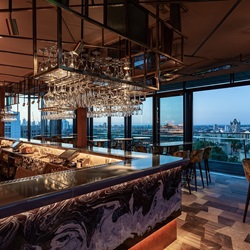
Savage Garden bar: Dispute over what happened
The Employment Appeal Tribunal (EAT) has set aside a ruling that City firm Fieldfisher unfairly dismissed a senior associate for sexual misconduct.
Lord Fairley, president of the EAT, found that the employment tribunal (ET) had wrongly substituted its own evaluation of the evidence that was before Ramatu Banga, the partner who decided to dismiss Djamshid Rustambekov.
As a result, the case was remitted to be re-determined by a differently constituted tribunal.
Mr Rustambekov was a senior associate in the dispute resolution team at Fieldfisher. He was dismissed in November 2023 as a result of two incidents.
First, it was alleged that in January 2023 he sexually harassed ‘Colleague 1’ (C1) by repeatedly inviting her to cancel her Uber and return with him to the office following a party organised by another employee.
Second, it was alleged that in July 2023 he had acted inappropriately toward ‘Colleague 2’ at a work party at the Savage Garden rooftop bar at a Hilton hotel near Tower Bridge, by following her to the toilets, placing his arm around her waist and waiting for her outside the toilet.
There was a third, more serious allegation of sexual assault involving C1 at the July party which was crucial to the case.
Though Ms Banga accepted that C1’s evidence about this was false, she decided that it was not deliberate.
The ET found there was no basis for her to reach this conclusion and that “the negative pull of C1’s lies is such that her allegation that the claimant harassed her in January 2023 is wholly undermined”.
The ET concluded that there was a defective investigation and disciplinary process.
Lord Fairley found that the ET had been wrong to substitute its own conclusion about C1’s credibility in relation to part of the July 2023 incident for that of Ms Banga.
“The allegation of sexual assault ultimately formed no part of the reason for the dismissal. In any event, the tribunal’s conclusion that C1 deliberately lied about an element of the July 2023 incident was not the only possible inference.
“As Ms Banga correctly recognised, it was at least possible that C1 was merely unreliable in her account of what happened.”
Ms Banga had the benefit of speaking directly to C1, which the tribunal did not. “Ms Banga also took account of all the evidence – including witness evidence of C1’s observed apparent distress – in reaching her conclusion that, whilst part of C1’s account was unreliable, she was not being deliberately untruthful.
“The tribunal’s substitution of its view that C1 had deliberately lied was based entirely upon a description by a third-party of the CCTV footage. That single piece of evidence was not an appropriate basis for the tribunal to substitute its own view that C1 was incredible rather than merely unreliable about a part of the July 2023 incident.”
The ET went on to make a “more significant” error in substituting its own assessment of “the negative pull of the lie” – an expression taken out of context from an immigration case – to the evidence that Ms Banga took into account in considering the January 2023 episode.
“It is tolerably clear that the tribunal reasoned that, had it been in the position of Ms Banga, it would have considered that the ‘negative pull of the lie’ that it had found to exist in relation to the July 2023 incident was wholly destructive of the credibility of C1 in relation to the January 2023 episode. That, however, was not the tribunal’s decision to make.”
Its task was instead “to determine whether, after reasonable inquiry, [Ms Banga] had reasonable grounds for concluding that the January 2023 episode happened in the way alleged”.
Lord Fairley found that she did. There were three sources of evidence against Mr Rustambekov’s bare denial.
The judge said: “A particular application of the principle that a tribunal must not simply substitute its own view of reasonableness is that it must not substitute its own evaluation of the evidence that was before the decision-maker.
“That, however, was exactly what the tribunal did in this case. That substitution led it to its erroneous conclusion that the respondent did not have reasonable grounds to conclude that the claimant had sexually harassed C1 in January 2023.
“Since that conclusion was a material part of to the tribunal’s reasons for concluding that the dismissal was unfair, its judgment to that effect must be set aside.”











