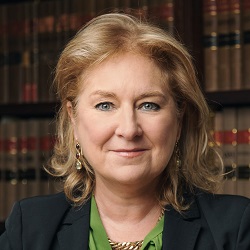
Carr: Led bench on key ruling
A high-powered Court of Appeal has overturned and completely rejected a High Court ruling that had opened a crack in advocates’ immunity.
Led by the Lady Chief Justice, Baroness Carr, it said the “core immunity” for advocates from legal actions based on what they said or did in court did “not need to be justified on a case-by-case basis”, as Mr Justice Ritchie had ruled.
The Bar Council said in July [1] that it intervened in the case because Ritchie J’s approach promoted uncertainty and “would be difficult to apply in practice”, as well having a “chilling effect” on “fearless” advocacy.
The claims in Chief Constable of Sussex Police and another v XGY [2025] EWCA Civ 1230 [2] arose from words spoken by a Crown Prosecution Service (CPS) advocate during a bail hearing at Brighton and Hove Magistrates’ Court.
A woman, ‘XGY’, had made several reports of domestic abuse against former partner, ‘DYP’, and stated that during their relationship he made threats to seriously harm her and members of her family.
Following the end of the relationship, XGY relocated but after DYP found out where she lived, she moved to a new address which she asked to remain confidential.
However, when DYP was brought to the magistrates’ court in a separate case, the police included XGY’s new address in the file without marking it as confidential.
During the hearing, the CPS advocate asked for a bail condition preventing DYP from going to the new address, which the advocate mentioned in open court. As a result, XGY left the property, arguing that this had worsened her depression and given her post-traumatic stress disorder.
She brought a claim against the CPS and Chief Constable of Sussex Police for misuse of private information, breach of the Data Protection Act 2018 and several breaches under the Human Rights Act 1998.
Her Honour Judge Brownhill struck them out on the basis of advocates’ immunity but Ritchie J allowed XGY’s appeal on all grounds.
On the central issue of immunity, he considered that “there was an immunity, but that recent case law meant that, at least arguably, it was limited, and had to be justified on a case-by-case basis (and could not be justified here)”.
The Court of Appeal – with Dame Victoria Sharp, president of the King’s Bench Division, and Lord Justice Coulson also sitting – held that he had wrongly interpreted the authorities.
It said: “If a claim falls within the scope of the core immunity or its established extensions, the claim must be struck out.
“To be effective, foreseeability is essential if those involved in the administration of justice are to speak freely. The approach of ‘justificationism’ [the word used by Ritchie J] fundamentally undermines the public policy underlying the existence of the immunity.”
Immunity was “not limited to evidential matters” but was “far wider in scope”, attaching to “statements (said or written) made in court” including at bail hearings, as in this case.
It was “wrong to consider”, as Ritchie J did, that it was “incumbent” on the CPS to file a defence when immunity was challenged.
“The CPS considered that it had a complete answer to the claim by reason of the core immunity, and was entitled to seek to strike out the claim without more on that basis.
“Similarly, it was wrong to conclude that the question of immunity could only be determined at trial, a conclusion perhaps explicable by reference to the reasoning on ‘justificationism’ which we have rejected.”
The “established extension of core immunity” that applied to police conduct meant that XGY’s claims against Sussex Police were also “doomed to fail”.
The Court of Appeal set aside the order of Ritchie J and struck out XGY’s claims against the CPS and Sussex Police. HHJ Brownhill’s conclusion on summary judgment that the HRA claims were “doomed to fail in any event” was reinstated.
The court concluded: “We wish to emphasise that nothing that we have said is intended to detract from the consequences for XGY of the disclosure of her Hampshire address. We would wish to express our sympathy for her and the situation in which she was placed.
“However, public policy and long-established principle mean that she does not have a legal remedy in these proceedings for what happened.”
Barbara Mills KC, chair of the Bar Council, commented: “In our intervention we sought to protect the core principle of immunity from liability for advocates and argued that those who participate in court proceedings should be able to speak freely, without fear of being sued.
“This principle is critical for access to justice and the administration of justice.”