


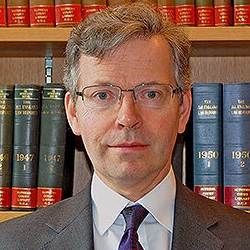
Fancourt: Fees cannot be justified
The Court of Appeal has described as “astonishing” a £2m brief fee for leading counsel, plus refreshers of £20,000 a day, to act on an appeal set to last four days.
In all, the respondents to the appeal expected to incur costs of more than £3.6m.
Lord Justice Fancourt, sitting with Lord Justice Phillips, made the comments in ordering that Russia pay nearly £1m in security for costs for the appeal, which will be heard next summer, instead of the £2.5m sought.
The case, which began in 2015, has been brought by three companies seeking recognition and enforcement of three arbitration awards made in The Netherlands.
The tribunal found Russia liable to pay them around $50bn in compensation, plus interest.
Following protracted proceedings in The Netherlands over the validity of the awards, a preliminary issue on state immunity was heard in the Commercial Court in 2023 and then by the Court of Appeal.
This went in favour of the claimants and Russia is now appealing a decision by Mr Justice Bright earlier this year on various other preliminary issues.
The claimants/respondents sought security for costs and Fancourt LJ said such an order would be “just”.
There was “self-evidently a real risk of inability to enforce a costs judgment” against Russia in the Russian courts, he said.
Russia was, “to put it at its lowest, strongly antipathetic” towards the claimants, and it was “determined not to pay a cent” of the arbitration awards.
But in deciding on the amount of security – the respondents sought 70% of the £3.6m – he described the costs as “extraordinarily large for a four day appeal”.
Counsel’s fees were £260,000 for leading counsel and £84,000 for junior counsel to deal with this hearing (which also included the question of whether to impose conditions on the permission to appeal, which the court declined to do).
Leading counsel’s brief fee for the appeal is £2m, plus £375,000 for junior counsel’s brief fee, with refreshers of £20,000 and £3,750 respectively. They are to be paid another £100,000 and £25,000 respectively to deal with the consequentials, including a half-day hearing.
Fancourt LJ said: “These sums are astonishing and cannot be justified, at least for these purposes. We cannot understand how a brief fee of £2,000,000, on top of all the highly paid work previously done to prepare the skeleton arguments, is appropriate. £125,000 for a consequential hearing that will not ordinarily take place is also unjustified.
“Mr Peters sensibly did not try to justify the fees, except on the basis of the excellence and seniority of leading counsel and market forces. However, that yardstick has little relevance to the criteria that the costs judge will apply, in the context of admittedly complex issues and substantial value on a four day appeal.
“However much the respondents choose to spend on their lawyers, the appellant can only be expected to pay what is reasonable and proportionate.”
Counsel for the respondents before Bright J were Jonathan Crow KC, David Peters KC, Guy Olliff-Cooper and Naomi Hart.
Approaching counsel’s fees on the basis of allowing a percentage of the schedule of costs was “unhelpful… as the schedule is too extravagant”. The court said £600,000 was sufficient security for counsel’s fees.
The court also had questions about the reasonableness of the £675,000 in profit costs put forward by the respondents’ solicitors, City firm Stephenson Harwood, citing “obvious questions about unnecessary duplication of work and the number of fee-earners involved at various stages”.
A sum of £375,000, to include also expected disbursements on court fees, transcripts and costs consultants’ fees, was appropriate, meaning the court ordered total security of £975,000.












Leave a Comment