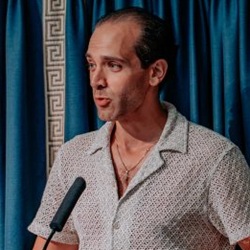
Alexander: Looking to appeal again
A man who spent more than 16 years in prison for the murder of his father has become the first serving prisoner to sit and pass the Solicitors Qualifying Exam.
Mark Alexander, who continues to protest his innocence, is now looking for qualifying work experience after his release in July this year.
Aged 22 at the time, he was sentenced to life imprisonment in 2010 with a minimum term of 16 years, when he had been just seven weeks away from graduating in law at King’s College London.
The body of Samuel Alexander, 70, was found buried in concrete in his garden in Buckinghamshire. Mark was said to have killed him to escape his “controlling influence”.
An initial appeal failed but there is a ‘Justice for Mark Alexander’ campaign gathering evidence for a fresh appeal to the Court of Appeal, as there was no DNA, blood or fingerprint evidence connecting him to what happened. In 2023, he won a landmark High Court ruling against the Ministry of Justice after his then prison’s governor rejected his request for a phone interview with a journalist investigating the case.
In 2016, Mr Alexander received a scholarship from the Longford Trust, a charity that supports young people to rebuild their lives through education after serving a prison sentence.
It was the Patrick Pakenham Award for Law – named after prison campaigner Lord Longford’s barrister son – which are specifically for prisoners wanting to study law. He was the first serving prisoner to receive it.
Writing on the Longford Trust website, he said: “When I first found myself in prison it took me a while to regain sufficient composure to actually approach studying again. Much of my energy was absorbed in challenging my conviction in the courts, but the sense of time slipping through my fingers like so many grains of sand became increasingly palpable.
“I knew I had to find a way to exercise meaningful agency in spite of my circumstances and transform time lost into time well invested. Education was the clearest answer.”
In 2017, he completed his KCL degree, obtaining a 2:1 after repeating his final year in prison. His marks were 20% higher on average than before his incarceration.
He then studied for an LL.M, graduating with a merit from UCL through the University of London.
Mr Alexander said he wanted to keep up the momentum when he moved to an open prison, so took on an MSc in social research methods at the London School of Economics and was able to attend lectures. He obtained a distinction and a place at Cambridge University, where he is now pursuing a part-time PhD in criminology.
“Somewhere in between those two things, I found time to squeeze in my solicitor training. The urge to do something in light of everything I had seen of the justice system was profound. The unsettling gap between the ideals espoused in our lecture theatres and the reality of legal practice was not something I could ignore.”
He took the SQE in January while on day release from prison. “Most of us walked into that exam thinking the rumours about its difficulty had been overhyped, but after 10 hours confined to a solitary computer booth, the line of sombre-faced hopefuls filing out of that exam centre in contemplative silence was a picture of existential angst,” he wrote.
“Looking around me at all of these people, I was almost certain I had failed. They had struggled in spite of being free, in spite of living in their own homes. I had licence conditions to meet and a prison to return to every night. Had I been too ambitious?”
But he was among the 53% who passed the SQE1 in January.
Even if Mr Alexander obtains qualifying work experience, he could not become a solicitor without passing the Solicitors Regulation Authority’s character and suitability test, for which he would have to disclose his conviction. Reports suggest that he would not seek to do this until his prospective appeal.
This year, Mr Alexander won the University of Law’s Postgraduate Significant Achievement Award, which recognises students who have overcome adversity, and demonstrated perseverance and resilience under difficult circumstances.
He praised the University of Law for not just “paying lip service to ‘inclusivity’”, but “embodying it and showing others the way”.
In September, it launched the Justice Affected Students Pledge, a charter designed to enhance support for students with lived experience of the criminal justice system, which universities are now being invited to sign up to.