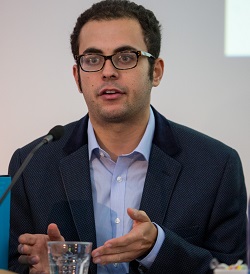
Browder: “Low-hanging fruit” ripe for automation
Up to 70% of the law can be carried out by robots and all legal documents will be automated within a decade, according to the student entrepreneur who created the ground-breaking DoNotPay chatbot.
He painted a picture of the future in which voice-activated chatbots would assist litigants-in-person and online courts would interact with chatbot representatives to dispense seamless automatic justice.
Speaking at the Legal Futures innovation conference in London on Tuesday, Josh Browder, who founded the free bot to challenge parking tickets, but which now covers hundreds of other legal issues, said creating tools for consumers to access justice at no cost to users is “my rebellion against the legal system”.
He added he was opposed to lawyers charging large amounts for “copying and pasting a few documents”.
He revealed that he planned “very shortly” to integrate his technology with Alexa, the intelligent personal assistant developed by Amazon: “For example, if your boiler breaks you can complain about your landlord to your house”.
Mr Browder continued that he believed the future of chatbots was voice input, rather than text, whereby instead of typing a legal problem into the chatbot, users would speak into it. Chatbots could even be used to help litigants-in-person conduct their cases in court by playing into an earpiece, he suggested.
He said the government’s investment in the Online Court was “really exciting”. He explained that once cases were heard online “then all you need is the chatbot to talk to the government bots, and once the bots talk to each other then it can be a fully streamlined case”.
He estimated 50-70% of legal work could be automated. “Low-hanging fruit” ripe for automation included divorces “where people don’t have any assets to split, don’t have any children and really they just want to file the forms to move on with their lives”. He claimed: “Even that is not being tackled by technology.”
Schooled in England but now a student at Stanford, California, Mr Browder – who designed apps from a young age – said he relocated so as to be in Silicon Valley, the “capital of technology”.
Being there had “changed my life”, he said, adding that seeing developments such as driverless cars had convinced him that “all” legal documents would be automated within a decade.
He went on: “Maybe I’m not the one to do it but I know there are thousands more programmers with decades more experience than me working on the law, financial technology, legal technology, and I know that in the next 10 years all of this stuff will be automated, even if I’m not the one to do it. I hope I am, though.”
He said technological developments such as blockchain would “actually prevent disputes before they happen. If you have a smart contract that executes itself then there’s no need to go to court to enforce it if one of the parties breaks it”.
Mr Browder explained that DoNotPay – which expanded from a “side project” aimed at friends and family – had so far “successfully appealed over 485,000 parking tickets, about a 50-50 split between the UK and the US” and that this showed governments used the tickets unfairly to raise revenue.
The chatbot now covered 300 legal documents, including “fighting your landlord or fighting retailers if they’re selling faulty goods”.
Future plans included “even more sophisticated stuff”, such as “for example you can press a button and get a no-fault divorce or press a button and sue someone in court”.
Divorce involved additional complexity, he recognised: “I’m working out how to actually transfer it to more complicated areas because a divorce is not like a parking ticket.”
Another area DoNotPay tackled was human rights, especially helping refugees file asylum claims. Chatbots were ideal for “fighting human rights abuse and the reason for that is that they are free and you can scale it to the millions of people who are unfortunately refugees”, he said.
Pressed on whether he accepted that lawyers added value, particularly by giving bespoke advice, Mr Browder said: “I think so and perhaps I am an interloper in the law and I have a lot to understand.
“But that said, the law is ultimately rules and… I think the fairest outcomes are when you can predict it and technology is good at predicting things.
“Obviously lawyers have a lot of experience but technology can read every brief that would take a lawyer a lifetime to read.”
He said that in future chatbots would have to include an “escalation procedure” involving referral up to lawyers when a case proved too complicated. Any chatbot that did not was “quite irresponsible”, he said.
Mr Browder said offering the services of his technology free was appropriate while he was a student and had “the privilege of not having to worry about making money”. But once he graduated this may change.
“Making it free is kind of my rebellion against the legal system,” he said.
He reported that the investors who earlier this month ploughed $1.1m (£840,000) into DoNotPay had urged him to continue to provide services free, although he acknowledged this approach to investment was a “bubble”.
Undercutting businesses profiting from “exploiting people” was its own reward, he suggested. This included lawyers who presented clients with “a £5,000 bill when… all you need is to copy and paste a few documents”.
He concluded “Technology poses a huge challenge to the legal profession and lawyers but I think it also poses a huge opportunity.”
Lawyers who understood technology and were willing to use it could prosper, while for others “it’s probably good to retire”.