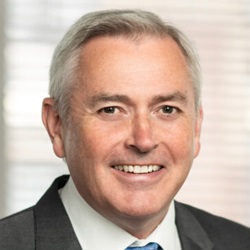
Hutchinson: Developing global service lines is measure of growth
Broadfield – the new international law firm supported by a global management consultancy – has achieved a lot in its first year but there is much more to do, according to its UK managing partner.
John Hutchinson said it had been “constant evolution on the edge of revolution on occasions”, but all in the direction of the plan for international expansion and “to create the global service at rational pricing and to deliver the right business outcomes for our clients”.
In late 2024, Southern England firm BDB Pitmans became Broadfield UK [1], the founder member of the firm.
It joined forces with SHP Legal Services – a subsidiary of global consulting firm Alvarez & Marsal – which provides management services to law firms joining Broadfield in the areas of technology, operations and talent acquisition.
At launch, Mr Hutchinson said they hoped to add at least six key European and US jurisdictions over two years in a bid to target mid-market private capital and corporate clients.
Since then, Broadfield has opened up in Hong Kong – in association with local firm Liu, Patrick Ling & Co – hired five partners to launch a New York office, recruited a private equity team into London and also set up a funds team in the capital.
Speaking to Legal Futures, Mr Hutchinson said these were the areas “that we believe will best service clients that have global aspirations, but are looking for high-quality value-driven services. And we continue on our journey to do that across other jurisdictions”.
The goal of six jurisdictions remained on track, he added.
The funds practice was an example of how Broadfield has changed the underlying law firm, he went on. “It’s an area where we’ve never historically had a strength, but we are growing that practice because of the international aspect.”
There has also been a technological transition to a central IT stack created by SHP, the adoption of Salesforce, AI system Harvey and NetDocs.
So it has been a transformation from what was a regional law firm – Bircham Dyson Bell was a London practice, Pitmans from the Thames Valley – to an international legal practice and a global service hub for the global practice.
Some lawyers have embraced it, some adapted to the change and others “decided it was not for them”.
Mr Hutchinson explained: “That’s perfectly normal when you have any change in a law firm, and we’ve seen that here. But the core of the business remains the same. We have good retention of people, and we’ve also attracted new talent in into those areas that we are developing.”
What about the reaction from would-be and existing clients? “It’s good in that we don’t have the baggage – we’re very open about the fact that we are a new firm that’s aiming to disrupt the market and do things differently. It can actually be an asset.
“In one or two cases, you have to explain to existing clients why we’ve done it, why it’s actually beneficial for them. For a lot of them, it’s the fact that we can access better technology. They know that the law needs to change.”
At the same time, surely there had to be some legacy local clients – say, an owner-managed car dealership in Berkshire – that no longer fit with Broadfield. “If we think the services a particular client needs aren’t consistent with what we do, then we tell them,” Mr Hutchinson said.
“But it’s a much broader church. So, for example, automotive is an area that the firm was always historically strong in. Large dealer groups, for example, want value and they want really good service, and that’s property, corporate, employment, tax, environmental, all of those things.
“So actually we do supply those services to SMEs locally as well as internationally, but the international growth is an area that obviously is part of the premise of Broadfield.”
BDB historically acted for national housebuilders that would not benefit from international operations.
“However, they do benefit from the fact that we can attract greater depth in talent in areas like finance, tax, and so on,” Mr Hutchinson said.
“We’re bringing in more bench strength and they appreciate that. Plus they too are sensitive to the costs that they’re being asked to bear and they want to see better service delivered in a more sophisticated way.”
In any case, the Thames Valley is home to a large number of tech businesses and Mr Hutchinson said “they’re actually very pleased to see us get stronger in private equity”.
The offer of high-quality services at a mid-market price is naturally appealing, but how do you actually deliver it?
“We’re not offering a cheap solution,” Mr Hutchinson stressed. “We’re not aiming to suggest that you can provide a premium service at cheap prices. But what we don’t do is just relentlessly chase the chargeable hour rate up. That to us is a flawed model and we think there’s an increasing number of sophisticated clients who believe that’s true as well.”
Mr Hutchinson described the arrangement with SHP as offering the best of private equity but without giving up ownership.
“You’ve got someone with committed capital that you can prosper alongside and you are aligned with – they want you to do well because obviously they will benefit from that and we want the long-term association.”
There has been a lot of change in the first 12 months but there is no sense of that slowing down. “I’m delighted that we have achieved what we have, but the ambition is huge and we expect to see a lot of growth coming in the next year.”
The measure of growth, he said, was not headcount – “that’s a function of success in delivering services clients want” – but developing global service lines.
And what, exactly, does being a disruptive force look like? “A year on we’re in three major jurisdictions, we are beginning to get client traction and moving into service areas where we have not previously been. We’re also attracting talent.
“You can only do that if there is something that’s exciting to the market about the Broadfield model.”