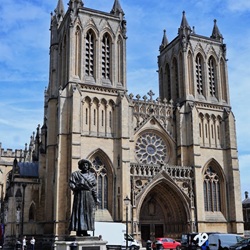
Bristol Cathedral: Ball was an organist
A barrister who sexually assaulted a child in 1992 and “used his position of trust to groom that victim” has been disbarred.
A Bar disciplinary tribunal said Ian Ball was convicted over 20 years later in 2014 for the assaults and for making indecent photographs of a child, but he failed to report this to the Bar Standards Board (BSB).
A BSB spokesman said that the regulator only found out about the convictions in 2024.
Mr Ball was convicted at Bristol Crown Court in April 2014 of four counts of indecent assault on a male contrary to section 15 of the Sexual Offences Act 1956 and seven counts of making indecent photographs of a child. He received a jail sentence of 30 months.
An internet search indicates that the assaults took place while he was an organist at Bristol Cathedral.
The tribunal said it “took into account the seriousness of the underlying offences” and the use of a position of trust to groom the victim.
It “had regard” to the sanction guidelines, which stated that a respondent should not generally be allowed to return to practise while they remained on the sex offenders register. Mr Ball, who admitted the charges, had also “invited the tribunal to disbar him”.
Both Mr Ball and the BSB applied for their costs to be paid by the other party.
The tribunal noted that Mr Ball had initially admitted breaching the Bar code of conduct but later, “once charges had been brought, denied them”.
He attempted to negotiate an outcome which would have resulted in his disbarment without the charges being pursued, but the BSB “was entitled to continue to maintain its position” that the public interest required it to pursue the prosecution. He finally admitted the charges in the week before the hearing.
The tribunal ruled that Mr Ball should pay the BSB costs of £2,200.
Although the tribunal accepted that it had the jurisdiction to anonymise the barrister’s name, “given the age of the convictions and the fact that the respondent has changed his name”, it would be “inappropriate to depart from the principle of open justice, which is set out within the tribunal rules”.