


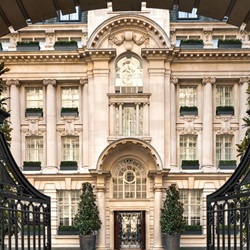
Rosewood Hotel: First incident occurred at after-work drinks
A senior male barrister who sexually harassed a female junior shortly out of pupillage “must have appreciated that he was in a position of power and importance” to her, a Bar disciplinary tribunal has held.
It rejected the submission that a suspension would be a sufficient sanction for Kevin Barry and disbarred him instead.
We reported last month that Mr Barry had been disbarred after he admitted three counts of misconduct in relation to ‘Person A’ during two social occasions over nearly three weeks in 2018, one at the Rosewood Hotel bar and the other a chambers’ silks party.
The tribunal, chaired by His Honour Martyn Zeidman KC, has now released the reasons for its decision to disbar.
In considering the aggravating factors, it said: “It is obvious to us that the respondent must have appreciated that he was in a position of power and importance in relation to Person A.
“She was shortly out of pupillage. He was the successful head of the criminal department. She had no work of her own and was dependent upon chambers.
“In the words of the complainant, ‘I was in the position of not wanting to upset someone who had an ability to impact my career, both within chambers and externally’.”
The level of Mr Barry’s professional experience “makes this all the worse”, the tribunal went on. It was “remarkable” that he was a high-grade criminal barrister, specialising in sexual offences as a major part of his practice. “The concept of consent was well known to him.”
The tribunal said Mr Barry continued to assert that he believed Person A was consenting. “He acknowledges that this was not a reasonable belief but he says that it was his belief at the time, albeit perhaps affected by the drink that he had consumed.”
Other factors included Mr Barry ignoring requests to stop and the harm suffered by Person A: “We have no doubt that the complainant suffered fear and anxiety which has had an impact on her wellbeing. In addition it has had an effect her working life and career.”
She has been in therapy and Mr Barry’s actions affected the way she reacted to other people.
“She explains how it has made her feel uncomfortable when touched by others and it causes flashbacks… The short-term impact of what he did was a huge physical transformation: ‘I noticed in the months that followed I also became more antisocial, less active and began to gain weight.’”
Another “very significant” aggravating feature was that in 2019, he was reprimanded and fined £3,000 after he engaged in “unwanted sexual conduct” towards his pupil. That event predated his conduct towards Person A, although he was not aware he was facing a complaint about it until afterwards.
The “first and best point” of mitigation was that Mr Barry admitted the charges, although it was only three weeks before the hearing that he admitted all of them.
He admitted and apologised as soon as the complaint was put to him by his head of chambers and at some stage offered to resign.
“This was not required of him by the head of chambers, but the point is that he offered to do so. Although having said that, he did not need the permission of anyone to leave chambers, and it would have always been open to him to have left chambers irrespective as to whether it was required of him.”
The tribunal noted that Mr Barry has “gone to great lengths to rehabilitate himself”, adding: “We accept entirely that at the time of these offences the respondent was feeling under great strain and was drinking to excess. He explained that in 2018 he was feeling as if he was suffering from a sort of mid-life crisis.”
Though as a result of therapy he stopped drinking all alcohol, he will now drink at home with dinner in a moderate manner.
“We are sorry that he has not maintained total abstinence from alcohol, as, despite his progress, this must carry a risk of escalation in his drinking and the potential for repetition of his wrongdoing.”
The tribunal went on: “We accept that he now feels remorse, one person referred to him as ‘a broken person’, and indeed since these events he has done very valuable charitable work as set out in the documents and that is to his credit.
“As the respondent put it in his mitigation statement, he has a deep-rooted sense of personal shame and self-hatred for the harm done to the victim, to family, to chambers and loved ones. It has been extremely painful telling family and friends, and he feels he has lost their respect.
“His marriage has teetered on the brink of collapse and the publicity of the earlier assault on Miss X gave rise to a great deal of adverse publicity as we can understand.”
There were many character witnesses and the tribunal agreed that “there are of course many aspects of his character which are impressive”.
However, it rejected the submission that justice could be done by a period of suspension.
The sanctions guidance said that disbarment was reserved for cases where “the need to protect the public or the need to maintain public confidence in the profession is of such a level that the only reasonable option is to remove the respondent from the profession”.
The tribunal concluded: “In our view, this is clearly such a case. We are sure that a suspension would not be sufficient.”











