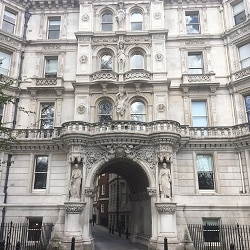
2TGC: Third set of proceedings
The Employment Appeal Tribunal has made a finding of apparent bias over the conduct of a judge in managing a discrimination claim brought by a barrister against his former chambers.
Bruce Carr KC, sitting as a deputy High Court judge, said [1] “the combination of significant questioning and criticism of the claimant in relation to unopposed matters, the determination of contested matters on bases that were not even argued by the respondents and which are in any event unsustainable, are in my view, sufficient to justify that conclusion”.
He was also “troubled by the vigour” with which Employment Judge (EJ) Graeme Hodgson “appears to have pursued the issue of further (unrequested) particularisation of an (uncontested) application to amend the relevant paragraphs”.
The claim is brought by Daniel Matovu, a barrister of more than 40 years call, against 2 Temple Gardens, from which he was expelled in 2019 after a complaint by its senior clerk.
Prior to the expulsion, he issued two sets of proceedings. In 2020, the employment tribunal rejected [2] the black barrister’s race discrimination and victimisation claim, a decision upheld by the Employment Appeal Tribunal [3]. The Court of Appeal refused permission to appeal.
Mr Matovu had issued a third claim centred on his expulsion, which was stayed pending the outcome of the appeals. This was lifted in 2024 and it was EJ Hodgson’s conduct of a preliminary hearing that was under scrutiny.
Two of Mr Matovu’s applications were to amend his particulars of claim. Despite the first being unopposed by counsel for the respondents, the judge engaged in “extensive discussion with the claimant, ultimately leading to requirements being attached to the grant of permission to amend”.
Judge Carr went on: “That this occurred against the backdrop of an extremely limited period being allowed for submissions is a further point on which the informed observer may start at the very least, to raise an eyebrow as to how the EJ was going about his task.”
EJ Hodgson also criticised Mr Matovu for not having sought to pursue the victimisation claim by issuing fresh proceedings instead.
Judge Carr continued: “He then said that, had the respondents taken objection to the amendment on the basis that the claims within it might be out of time, he this would have ‘weighed heavily’ with him in his decision. In those circumstances, the impartial observer would be likely to ask him/her-self why the EJ was making any reference to this at all?”
There appeared “no need” to make the “unnecessary and irrelevant observation criticising the claimant for not issuing a fourth claim”.
The second application to amend, so that he could argue that his expulsion had been an act of victimisation, also went against the barrister “but on grounds which again, had not been argued by the respondents and which had not been the subject of discussion at the hearing”.
Indeed, Judge Carr observed, not only had counsel for the respondents not suggested that the amendment would give rise to the need for further evidence or broaden the scope of the factual inquiry, but EJ Hodgson himself “gave the same indication during the course of the hearing” – only to come to the opposite decision in his written reasons.
It was “surprising to say the least” that EJ Hodgson “took it upon himself to reject the application on that basis”.
EJ Hodgson also refused an application to order the respondents to provide further information on the grounds that it was excessive – but this too was not argued by the respondents. In any event, this was also not a sustainable objection, Judge Carr said.
He concluded that the “cumulative” effect of what happened led to a finding of apparent bias.
“The combination of significant questioning and criticism of the claimant in relation to unopposed matters, the determination of contested matters on bases that were not even argued by the respondents and which are in any event unsustainable, are in my view, sufficient to justify that conclusion.”
Judge Carr upheld the appeal both on the ground of perversity – that no reasonable tribunal could have reached the decisions to refuse the second and third applications – and apparent bias in EJ Hodgson’s conduct of the hearing.
He ordered that EJ Hodgson have no further involvement in the case.