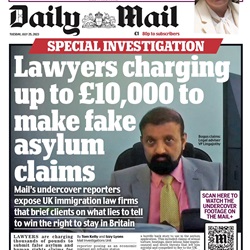
Daily Mail: Just an initial exploratory meeting
Two of the three solicitors accused by the Daily Mail [1] of offering to help an undercover reporter concoct a false asylum claim have now been cleared of misconduct.
The Solicitors Disciplinary Tribunal (SDT) found that Muhammad Nazar Hayat had merely conducted an “initial exploratory meeting” and the furthest he went during it “was to rehearse potential arguments at their highest”.
But he made it clear that they would be revisited at a future meeting, with the grounds of the asylum claim to be finalised based on the evidence presented by his prospective client.
After the newspaper’s front page story in July 2023, the Solicitors Regulation Authority (SRA) – which was under huge political and media pressure – closed the three firms [2] named after receiving the recordings and transcripts from the newspaper. The heads of each were referred to the SDT [3].
The first, Rashid Ahmad Khan, was cleared earlier this year [4] for similar reasons to Mr Hayat. The case of Muhammad Azfar Ahmad, director of Kingswright Solicitors in Birmingham, has yet to be heard.
Mr Hayat, who qualified in 2013, was the owner and manager of Lincoln Lawrence in west London.
The SDT heard that the undercover reporter posed as a recently arrived illegal migrant with no legitimate reason to claim asylum, and asked if there was anything the solicitors could do to normalise their stay in the UK.
The reporter was told by the newspaper not to ask leading questions, not to suggest making an asylum application and, if asked, to be clear that there was no basis for a legal claim for asylum.
It was “immaterial” that the allegation arose from a ‘sting operation’, the SDT said.
It noted that, for the initial meeting with the reporter and two of his colleagues – posing as relatives – there was no retainer in place, no fees were paid and no client-care letter provided.
“The tribunal concluded taking this context into account that the respondent was advising his purported client at what was an exploratory meeting during which the respondent sought to establish what steps were appropriate and potentially available to his prospective client.
“The respondent provided advice on the type of evidence that should be obtained and on the asylum process generally.”
Mr Hayat was “an unsatisfactory witness and many of his answers were irrelevant and incoherent” but the SDT nonetheless accepted his evidence on several key aspects of the case.
English was not his first language, it said. This was relevant because it affected both the specific phrases and terminology he used when speaking with the journalists and his explanations to the tribunal.
“His choice and use of language may otherwise have appeared unusual if not viewed in this context.
“The tribunal found that where the respondent used terms like ‘create’ or ‘make’ evidence or ‘make a story’ he was referring to the evidence that would need to be brought before the Home Office.
“The respondent was not referring to or advising on fabricating evidence; his words instead reflected the process by which evidence would be collated and pulled together, including by the client ahead of their next meeting.”
The SDT decided that Mr Hayat did not advise the reporter to create a false narrative and was at most rehearsing potential arguments. He did not act dishonestly, as alleged by the SRA.
Costs are only awarded against the SRA in unsuccessful prosecutions if improperly brought and the tribunal said this was not the case here.
The evidence was such that it was “entirely appropriate for the case to be heard” and Mr Hayat’s explanations “thoroughly examined” by the tribunal. It made no order for costs.